PHA vs AHA vs BHA: A Beginner’s Guide to Chemical Exfoliants
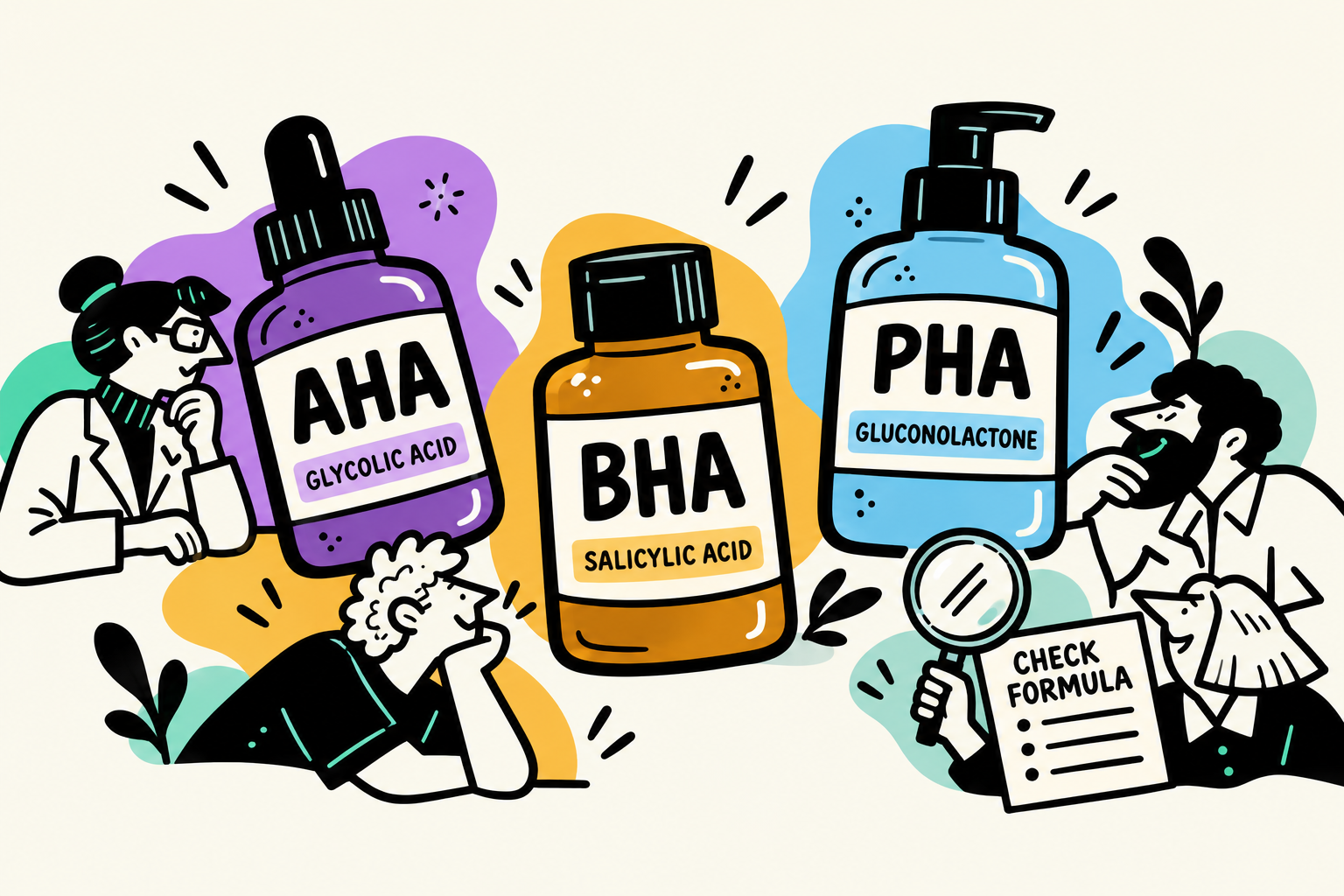
AHA, BHA and PHA are families of exfoliating ingredients. The useful comparison is the concern you want to address, the exact ingredient and the finished formula. A Korean brand name or a “gentle” label does not tell you the strength of an acid product.
AHA vs BHA vs PHA at a Glance
| Family | Ingredients to recognize | Common reason to consider it | Main caution |
|---|---|---|---|
| AHA | Glycolic acid, lactic acid | Surface texture and dullness | Irritation and increased sun sensitivity; concentration and pH matter. |
| BHA | Salicylic acid; some products instead use betaine salicylate | Blackheads and pore congestion | Do not equate different salicylates or percentages. |
| PHA | Gluconolactone, lactobionic acid | An alternative when investigating gentler exfoliation | Gentler marketing is not proof of suitability for reactive skin. |
This table is a starting point, not a prescription. You do not need all three, and you may not need an exfoliant at all. If the skin is currently stinging, inflamed or recovering from over-exfoliation, adding another acid is not the next step.
AHA: Read the Formula, Not Just the Acronym
The FDA’s AHA overview explains that the extent of exfoliation depends on acid type, concentration, pH and other ingredients. A percentage alone cannot tell you exactly how two finished products will compare.
Glycolic and lactic acid are recognizable examples. However, seeing an acid on a list does not establish that the product is intended as an exfoliant: an acid can have another formulation role. Check the product’s purpose and directions.
A peeling gel is not automatically an AHA product. Product rolling or pilling is also not a measurement of how much dead skin has been removed. Use the actual ingredient list rather than assigning an acid category from the texture or product name.
BHA: Salicylic Acid and Betaine Salicylate Are Not Interchangeable
Salicylic acid is the familiar BHA used in skincare discussions about congestion. A Korean example often mentioned in the same conversation is COSRX BHA Blackhead Power Liquid, but its official ingredient list names betaine salicylate. It should not be described as the same formula as a salicylic-acid product.
COSRX lists this product for users with acid experience and advises gradual introduction. Follow that product’s current directions and your own response rather than treating it as a universally gentle beginner toner. A brand’s ingredient or oil-control description is not an independent comparative trial.
If you already use an acne treatment, ask your clinician how an exfoliant fits around it. More acid is not automatically better treatment, and combining products can complicate the cause of irritation.
PHA: A Possible Alternative, Not a Guarantee
Gluconolactone and lactobionic acid are names to look for when checking a PHA product. Products marketed around PHA may appeal to people who found another exfoliant uncomfortable, but tolerability still depends on the whole formula, use pattern and individual skin.
I would not recommend an acid solely because someone has rosacea or very reactive skin. Those concerns need an individual assessment. Do not use a generic PHA category description as evidence that a particular pad or toner is suitable.
Pads also introduce a physical rubbing step. A PHA ingredient does not make repeated wiping harmless. Check both the formula and the way the product is applied.
Korean Examples Without the National Stereotype
COSRX’s ingredient explainer lists both low-concentration AHA products and an AHA 7 product. This is a useful counterexample to the idea that every Korean exfoliant is weak or designed for frequent use. The page is a manufacturer source.
For a multi-acid product such as Some By Mi AHA-BHA-PHA 30 Days Miracle Toner, treat the name as a prompt to inspect the formula. My separate review covers that product rather than using it to rank all three acid families.
A low percentage, several acids in one bottle or a “daily” label does not guarantee that a finished product will be comfortable. Do not calculate a treatment schedule from the country of origin.
How to Introduce One Product
Choose one concern and one product. Read whether it is leave-on or rinse-off, then follow its directions. Avoid introducing a second exfoliant at the same time; otherwise it is difficult to identify which change caused a reaction.
The American Academy of Dermatology’s exfoliation guidance emphasizes that exfoliation is not for everyone and that the schedule should reflect skin and method. There is no universal two-to-four-times-a-week starting rule for every acid.
Consider the rest of your routine, including retinoids or other acne products. Do not stack several new actives to speed up results. If irritation develops, stop and reassess rather than increasing frequency to “push through.” For my experience of doing too much, see the barrier recovery diary.
Sun Protection and Placement in a Routine
FDA guidance notes that AHAs can increase sun sensitivity. Follow the product’s sun-protection warning and maintain sunscreen and other protective habits. A PHA label is not a reason to skip them.
For a leave-on exfoliant used after cleansing, follow with the rest of your compatible routine as directed. A separate hydrating toner is optional. A rinse-off product has different instructions, so “thin to thick” is not a substitute for the label.
Quick Answers
Which should a beginner buy? There is no compulsory first acid. Start from the concern and the directions, and consider skipping exfoliation if the skin is comfortable without it.
Can I combine all three? A finished multi-acid formula and layering three separate products are different situations. Neither the ingredient count nor a low-strength claim establishes suitability for you.
Do I also need a scrub? No additional scrub is required simply because you use an acid. Avoid adding friction and another exfoliating step without a clear reason.
Is Korean exfoliation safer? Country of origin does not establish safety or clinical superiority. Compare the actual product and use pattern.
Read Next
Pure Vitamin C vs. Derivatives: Which One Is in Your Brightening Serum?
Two serums both say vitamin C on the front. One stings slightly, comes in an…
What Does “Emulsify” Mean in Skincare? A Cleansing Oil Explainer
In cleansing-oil instructions, “emulsify” means adding water and gently working it through the cleanser so…
Retinol vs. Retinal vs. Bakuchiol: Korean Anti-Aging Actives Compared
Anti-aging ingredient choice has gotten more complicated in recent years as retinal and bakuchiol have…
Adenosine: Korea’s Officially Approved Anti-Wrinkle Ingredient
Adenosine occupies a unique regulatory position in Korean skincare that most international shoppers never realize:…
What Does “Hanbang” Mean in Korean Skincare?
“Hanbang” appears constantly in Korean skincare marketing (printed on packaging, used in brand descriptions, referenced…
What Is Cica? Centella Asiatica Meaning, Benefits, and How to Use It
If snail mucin was the ingredient that introduced the world to K-beauty in the late…