What Is Cica? Centella Asiatica Meaning, Benefits, and How to Use It
If snail mucin was the ingredient that introduced the world to K-beauty in the late 2010s, Centella asiatica, universally shortened to “Cica” in Korean marketing, is the ingredient that has kept sensitive-skin sufferers loyal to Korean skincare ever since. Walk through the skincare aisles of any Korean drugstore and the word “시카” (sika, the Korean transliteration) is nearly unavoidable, printed across everything from cushion compacts to sleeping masks. Here’s what it actually is and why it earned that reputation.
This article is general information, not medical advice. If you’re dealing with persistent acne, rosacea, eczema or another skin condition, please see a dermatologist.
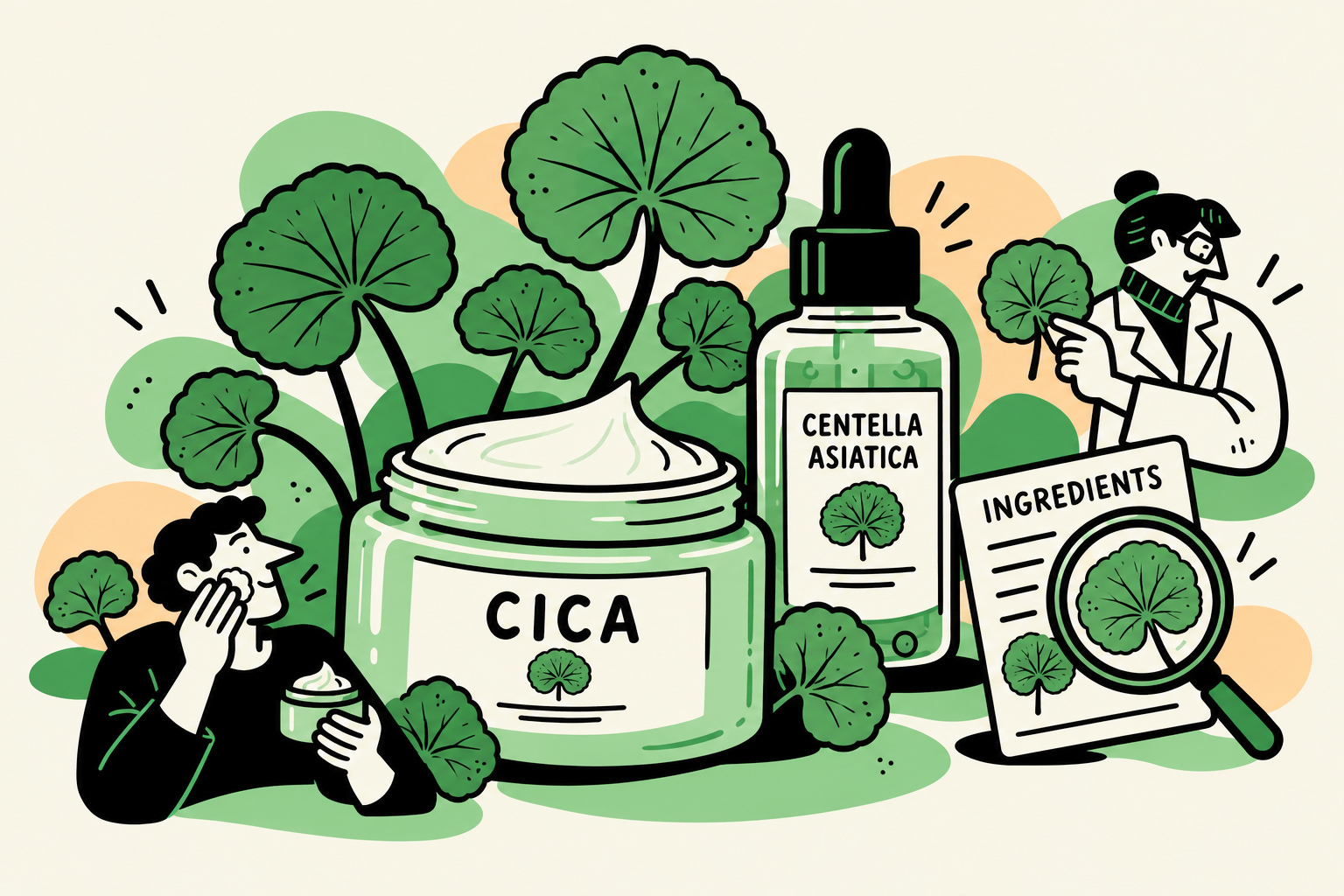
Cica is short for Centella asiatica, a medicinal herb also sold under the names gotu kola and tiger grass. In skincare, “cica” on a label means the product is built around centella extract or one of its isolated compounds (madecassoside, asiaticoside, madecassic acid and asiatic acid) which calm visible irritation and help repair a damaged skin barrier.
In this guide
- What Is Centella Asiatica?
- Cica vs. Centella: Are They the Same Thing?
- The Active Compounds Behind the Hype
- Why It Became Korea’s Go-To Sensitive Skin Ingredient
- The 2017-2019 “Cica Craze” in Korea
- Who Should Use Cica Products
- How to Incorporate Cica Into a Routine
- Popular Korean Cica Products
- Centella Asiatica: Your Questions Answered
- Should You Care About Centella Asiatica?
What Is Centella Asiatica?
Centella asiatica is a small, leafy herb native to wetlands across Asia, known in various contexts as “gotu kola,” “tiger grass,” or in Korean, “병풀” (byeongpul). Its use in Korean skincare traces back to a specific piece of folklore that Korean beauty marketing still references constantly: tigers in the wild were said to roll in patches of the plant to heal wounds, which is how it earned the “tiger grass” nickname that international brands like Dr. Jart+ built entire product lines around (their Cicapair line is arguably the single most internationally recognizable Cica product).
Beyond folklore, centella asiatica has a long history in traditional Korean and broader East Asian herbal medicine as a wound-healing and skin-soothing botanical, which is what eventually attracted modern cosmetic chemists’ attention.
Cica vs. Centella: Are They the Same Thing?
Yes. They are the same plant, and the difference is purely one of naming. “Centella asiatica” is the botanical name. “Cica” is the abbreviation Korean brands put on packaging because it is shorter and easier to say across languages, and it stuck so firmly that many people now assume the two are separate ingredients. “Tiger grass” is a third name for the same plant, borrowed from the folk story that wounded tigers rolled in it to heal.
The part worth knowing is what the word does not tell you. “Cica” on a front label says nothing about which form of the plant is inside or how much of it. A product can contain whole-leaf centella extract, centella leaf water, or one isolated compound such as madecassoside, and all three are allowed to call themselves cica. The isolated compounds are the ones with the strongest evidence behind them, and madecassoside in particular is what Korean pharmacy healing ointments are built on, but they are also the most expensive. A cheap cica cream is far more likely to be using a dilute leaf extract.
This is why I stopped shopping by the word on the front and started turning the bottle over. If centella or one of its compounds sits in the first third of the ingredient list, the product is probably formulated around it. If it appears after the fragrance and the preservatives, it is probably present in a small amount, so I treat the name on the front with caution. List position alone does not prove whether a product works, so I look at the whole formula as well.
The Active Compounds Behind the Hype
Centella asiatica’s effects come primarily from a group of compounds called triterpenoids, specifically:
- Madecassoside. The most studied of the group, associated with anti-inflammatory and wound-healing effects
- Asiaticoside. Supports collagen synthesis and has documented wound-healing properties in clinical literature
- Asiatic acid and madecassic acid. Contribute to the antioxidant and anti-inflammatory profile
Some premium Korean Cica lines, notably Dr. Jart+ and SKIN1004, specifically highlight “madecassoside content” on packaging (SKIN1004’s Madagascar Centella line is named for the specific source region of their centella extract, which they market as higher-potency than typical formulations).
Why It Became Korea’s Go-To Sensitive Skin Ingredient
Korea’s skincare culture has a notably high awareness of skin sensitivity and irritation. The concept of a compromised skin barrier (“피부장벽,” pibu jangbyeok) is discussed far more explicitly and frequently in Korean skincare marketing and dermatology content than in most Western markets. This is partly cultural (an emphasis on gentle, preventive skincare over aggressive treatment) and partly practical: Seoul’s air pollution, seasonal extremes (brutally dry, cold winters followed by humid summers), and the widespread popularity of exfoliating and brightening actives all create real barrier-stress that consumers are actively trying to manage.
Cica products became the default answer to “my skin is reacting to something, help.” This is different from how the ingredient is sometimes marketed abroad as a general-purpose “trendy” addition. In Korea, it occupies a specific, almost medicinal niche as the go-to soothing ingredient, similar to how aloe vera is used in other markets, but with considerably more clinical research behind it.
The 2017-2019 “Cica Craze” in Korea
It’s worth understanding the specific market moment that made Cica ubiquitous. Dr. Jart+ (a Korean brand, despite the name sounding vaguely French or American) released the Cicapair Tiger Grass Color Correcting Treatment around 2017, marketing it explicitly as a soothing treatment for redness and irritation with color-correcting properties. It became a massive commercial success both domestically and in export markets like the US (particularly through Sephora), which triggered a wave of competing “Cica” product lines from nearly every major and indie Korean brand. SKIN1004, Anua, Isntree, Purito, and VT Cosmetics all released Cica-centered lines within roughly two years of each other.
This is a useful case study in how K-beauty trends actually spread: a single breakout hero product from one brand typically triggers an entire category shift across the industry within 12-24 months, rather than trends emerging gradually.
How Strong Is the Evidence for Centella?
Centella is a plausible soothing ingredient, but the research behind it is thinner than the marketing suggests. Michelle Wong of Lab Muffin notes that most studies are in vitro or in animals, and that the one decent human trial she found reported improved crow’s feet with an asiaticoside cream (Lab Muffin, centella asiatica spotlight). A 2021 review of its effects on skin conditions describes clinical studies in burn wound healing and recovery after laser resurfacing, but concludes that more rigorous long-term human trials are still needed (Pharmacological Effects of Centella asiatica on Skin Diseases).
In practice that means centella is a reasonable, low-drama layer for irritated or reactive skin, but it is not a proven treatment for scars, acne or wrinkles. Many studies also test it in combination with other ingredients, so a good result cannot always be credited to centella alone. Concentrations vary widely between products, and, as with any botanical, some people report breakouts or sensitivity, so patch-test a new cica product first.
Who Should Use Cica Products
Ideal for:
- Reactive, easily-irritated, or rosacea-prone skin
- Post-procedure skin (after laser treatments, chemical peels, or microneedling, a huge market in Korea given the popularity of dermatology clinics in areas like Apgujeong and Gangnam)
- Acne-prone skin dealing with inflammation, since Cica’s anti-inflammatory properties can help calm active breakouts without the drying effect of typical acne treatments
- Anyone actively using stronger actives (retinoids, AHAs/BHAs) who wants a soothing layer to offset potential irritation
Less critical for:
- Very tolerant, non-reactive skin without redness or sensitivity concerns. Cica won’t hurt this skin type, but it also won’t be solving a problem you have
How to Incorporate Cica Into a Routine
Cica products come in nearly every format, which makes them flexible:
- Cica toners/essences. Used early in a routine for a soothing base layer
- Cica creams. Often used as the final moisturizing step, especially at night
- Cica sheet masks. A popular “emergency” treatment after sun exposure, a bad reaction to a new product, or post-procedure care
- Cica spot treatments. Targeted use on active breakouts or irritated patches
A common Korean routine pattern for sensitive or compromised skin is to simplify down to just three or four Cica-forward products (cleanser, Cica toner, Cica serum, Cica cream) during a “barrier repair” period after over-exfoliating or reacting to a new active, sometimes called a “skin fasting” or “skinimalism” approach in Korean skincare community discussions.
Popular Korean Cica Products
- Dr. Jart+ Cicapair Tiger Grass Color Correcting Treatment. The product that started the craze
- SKIN1004 Madagascar Centella Ampoule. A cult-favorite budget option with a high concentration of centella extract
- Anua Heartleaf 77% Soothing Toner. Technically heartleaf (another soothing botanical), frequently used alongside Cica products in layering routines and worth knowing since the two are often confused
- Purito Centella Green Level Buffet Serum. Combines Cica with several other calming ingredients in one multi-tasking serum
- VT Cosmetics Cica Reti-A Cream. Combines Cica with a mild retinoid for an anti-aging angle that offsets typical retinoid irritation
What I’ve Noticed Using Cica Products Myself
My skin is slightly oily and sensitive, and I’ve used cica in two quite different ways: as everyday skincare from Round Lab’s Pine Calming Cica line, and as part of a barrier recovery routine after a glycolic acid toner left my cheeks red and bumpy.
From the Round Lab line, each product did something different. The Pine Calming Cica Pads were the standout: large, thick and embossed, and the small bumps on my skin calmed down while I was using them. The Pine Calming Cica Cream Plus absorbed quickly with a fresh finish. The ampoule, on the other hand, felt slippery and I didn’t notice a dramatic calming effect.
During recovery, the serum I’ve relied on is The Ordinary’s Soothing & Barrier Support Serum, which combines centella compounds (asiaticoside, madecassic acid and asiatic acid) with vitamin B12, ceramides and other soothing ingredients. It never stung, even at the worst point. I can’t credit centella alone, since the formula has several calming ingredients, but that pairing reflects a sensible way to use cica: alongside barrier-repair ingredients, not as a quick fix on its own.
Centella Asiatica: Your Questions Answered
Is Cica the same as Centella Asiatica? Yes, “Cica” is simply the shortened marketing term used across Korean and international packaging for Centella asiatica extract.
Can I use Cica every day? Yes, and most dermatologists recommend it specifically because it’s gentle enough for daily, even twice-daily, use without a break-in period.
Is Cica the same as CICA (an acronym some brands use for “Controlled Inflammation of the Cutaneous Area”)? Some Western brands have retroactively created acronym backronyms for “CICA” as a marketing device, but the ingredient itself is derived from Centella asiatica. The acronym versions are just branding.
Does Cica help with acne scarring? It can help reduce redness and inflammation associated with active acne and support the skin’s natural healing process, but it isn’t a strong pigment-correcting ingredient on its own. Pairing it with niacinamide or vitamin C is more effective for actual scar discoloration.
Should You Care About Centella Asiatica?
Centella asiatica earned its place in Korean skincare not through viral marketing alone but because it addresses a real, widely-shared concern in Korean skincare culture: barrier sensitivity and irritation. If your skin reacts easily, runs hot, or you’re recovering from over-exfoliation or a professional treatment, a Cica product is one of the most well-supported, low-risk additions you can make to a routine.
If centella hasn’t worked for you, mugwort is another Korean calming ingredient worth knowing about.
Read Next
What Is Snail Mucin and Why Is It in Every K-Beauty Product?
If you’ve spent more than five minutes browsing a K-beauty section, whether that’s a shelf…
The Azelaic Acid pH Controversy: What It Actually Proves (And What It Does Not)
This is the second post in a series about reading what is actually in a…
Pure Vitamin C vs. Derivatives: Which One Is in Your Brightening Serum?
Two serums both say vitamin C on the front. One stings slightly, comes in an…
Adenosine: Korea’s Officially Approved Anti-Wrinkle Ingredient
Adenosine occupies a unique regulatory position in Korean skincare that most international shoppers never realize:…
What Does “Hanbang” Mean in Korean Skincare?
“Hanbang” appears constantly in Korean skincare marketing (printed on packaging, used in brand descriptions, referenced…
Retinol vs. Retinal vs. Bakuchiol: Korean Anti-Aging Actives Compared
Anti-aging ingredient choice has gotten more complicated in recent years as retinal and bakuchiol have…