The Azelaic Acid pH Controversy: What It Actually Proves (And What It Does Not)
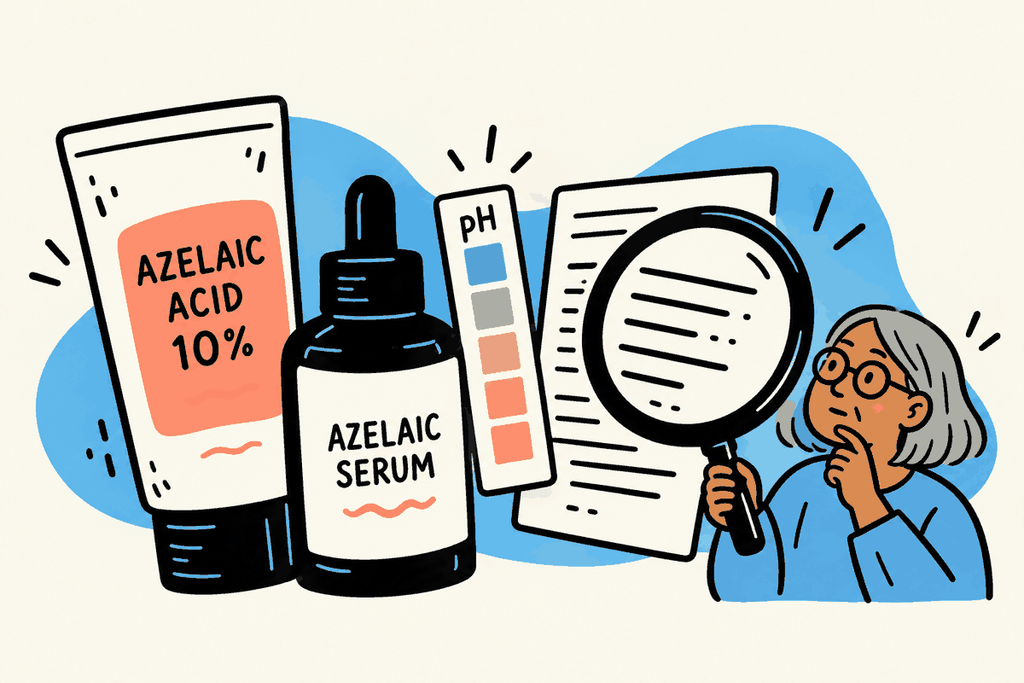
This is the second post in a series about reading what is actually in a bottle. The first one covered the general method. This one takes a specific argument that has been running loudly since August 2026 and works through whether it holds up, because it is a good example of a criticism that is partly right and confidently overstated.
The short version of my conclusion: the chemistry behind the complaint is real, the accusation built on top of it is not supported, and neither side can actually settle this from a pH reading and an ingredient list.
Why a Watery 10% Azelaic Serum Is Hard to Make
Azelaic acid dissolves in water at roughly 0.24 grams per 100 millilitres at room temperature. A 10% formula needs about ten grams in the same volume, which is more than forty times what plain water can hold.
This is not a minor formulation inconvenience. It is the central fact about the ingredient, and it is why the most familiar over-the-counter version, The Ordinary’s suspension, is a thick silicone paste rather than a serum. Suspending undissolved particles is the crude solution, and the texture is the price.
So when a clear, light, pleasant serum claims 10% or 16% azelaic acid, something else is going on. The reasonable question is what. The unreasonable leap is to assume the answer must be dishonest.
The Ways Brands Get Around It
| Approach | What you get | What it costs |
|---|---|---|
| Suspension | Undissolved particles held in a silicone base | Thick, grainy, pills under makeup |
| Solubilisation | Co-solvents such as glycols carry the acid into solution | Needs a lot of solvent; can sting |
| Partial neutralisation | A base raises pH so the acid converts to ionised azelate | Comfortable and stable, but changes which chemical species is present |
| A different molecule | Derivatives such as potassium azeloyl diglycinate | Not azelaic acid, and should be listed as itself |
The last row is the one worth knowing about generally, and it is also the one that is easy to check: a derivative has its own INCI name and cannot legitimately be listed as azelaic acid. If the ingredient list says azelaic acid, azelaic acid was used. The argument that has actually been running is about the third row, which is subtler.
What the pH Argument Claims
Azelaic acid is diprotic, meaning it has two acidic groups, with dissociation constants around 4.53 and 5.33. As pH climbs through that range, the proportion of the molecule sitting in its neutral form collapses.
At pH 4.5 the mix is roughly 48% neutral, 45% singly ionised and 7% doubly ionised. By pH 5.5 it has flipped to about 4% neutral, 39% singly ionised and 57% doubly ionised. Two Korean serums at the centre of the discussion, Anua’s Azelaic Acid 10 Hyaluron Redness Soothing Serum and Medicube’s Azelaic Acid 16 Calming Serum, were reported at a pH near 5.9.
From there the viral version of the claim took a short step to a strong conclusion: above that range the ingredient is essentially inert, so these products are selling a number rather than an effect.
The premise is chemically correct. The conclusion rests on an assumption the premise does not contain, which is that only the neutral form does anything.
What the Evidence Actually Shows
The study most often cited in this argument compared a pH 3.9 suspension against a pH 4.9 solubilised formula and measured how much crossed the skin.
The higher-pH, more ionised formula delivered roughly five times more ionised material, 128.4 against 27.7 micrograms per square centimetre per hour. But total delivery across both formulas differed by only about 21%. In other words, the ionised species crossed the skin perfectly well. It simply is not true that raising the pH switches the ingredient off.
That finding cuts against the viral claim. It does not, however, vindicate any particular product, and the study comes with the caveats such studies always do. It used mouse skin in diffusion cells rather than human faces. It used a vehicle containing 25% hexanediol, which is not what is in these serums. And it measured transport, not whether anyone’s redness improved.
So the honest position after reading it is that ionised azelaic acid penetrates, and that we do not know how these specific formulas perform, because nobody has tested these specific formulas.
So Is It a Scam?
No, and I want to be clear about that because the accusation travelled much further than the correction will.
A product listing azelaic acid at a stated percentage, at a pH where much of it is ionised, is a legitimate formulation choice with published evidence that the ionised form is absorbed. It is a different product from a low-pH suspension, and it is reasonable to prefer one over the other, but “different” and “fraudulent” are a long way apart.
What is fair to say is that the comfortable versions are making a trade. Higher pH means less sting and better texture, which means people use them consistently, which is worth a great deal. Whether the trade nets out in favour of the gentle formula or the aggressive one is exactly the question no one on either side of this argument has the data to answer.
What Would Actually Settle It
A pH strip and an ingredient list cannot tell you how a finished formula behaves. Delivery depends on the concentration, the solvent system, how far the acid has been neutralised, how stable the whole thing is over its shelf life, and how it interacts with skin rather than with a membrane in a lab.
What would settle it is finished-product testing on human skin, published by the brands, comparing their formula against a reference. That is expensive and rarely done at this price point, which is why this argument will keep recurring with the next ingredient.
In the meantime the practical advice is unchanged from the first post in this series: read the list, check what form the ingredient is in, and treat a confident claim in either direction as a reason to look closer rather than a conclusion.
Quick Questions
Should I return my watery azelaic serum?
Not on the basis of this argument. If it has been working for you, that is a better piece of evidence about your skin than a pH figure is. If it has done nothing in three months, that is a reason to try something else, as it would be for any product.
Is potassium azeloyl diglycinate the same thing?
No. It is a separate molecule with its own INCI name, far less evidence behind it, and it cannot be listed as azelaic acid. It appeared in a lot of the surrounding discussion but was not what these two products were using.
Does a stinging product mean it is working?
No. Sting tracks pH and solvent content, not effectiveness. A low-pH suspension will usually sting more than a neutralised serum and that tells you about the formula’s comfort, not its results.
How would I test the pH myself?
You can, with strips or a meter, and people have. The problem is not that the reading is wrong. It is that the reading on its own does not tell you what you want to know, which is how much active reaches your skin.
Which would you buy?
I use the suspension because I tolerate it and it is cheap, and I would happily recommend a watery version to anyone who would not stick with a gritty one. The version you actually apply four nights a week beats the theoretically superior one in the drawer.
Wrapping Up
This series exists because the front of a bottle and the back of a bottle often say different things. This particular case is the opposite problem: the back of the bottle was accurate, and a real piece of chemistry was stretched into an accusation it could not support.
Both failures come from the same habit of wanting a single number to decide everything. A percentage does not, a pH does not, and an ingredient list only gets you part of the way. Knowing which part is the whole skill.
Read Next
The Niacinamide + Zinc Combo Behind a Simple, Repeatable Morning Routine
Why so many Korean morning skincare routines stay identical every day, and the specific ingredient pairing doing most of the work.
Adenosine: Korea’s Officially Approved Anti-Wrinkle Ingredient
Adenosine occupies a unique regulatory position in Korean skincare that most international shoppers never realize:…
PHA vs AHA vs BHA: A Beginner’s Guide to Chemical Exfoliants
AHA, BHA and PHA are families of exfoliating ingredients. The useful comparison is the concern…
What Is Snail Mucin and Why Is It in Every K-Beauty Product?
If you’ve spent more than five minutes browsing a K-beauty section, whether that’s a shelf…
Propolis in Korean Skincare Explained: Benefits, Products, and How to Use It
Propolis has quietly become one of the more consistently used ingredients across Korean skincare’s brightening…
What Is Cica? Centella Asiatica Meaning, Benefits, and How to Use It
If snail mucin was the ingredient that introduced the world to K-beauty in the late…