What Is Snail Mucin and Why Is It in Every K-Beauty Product?
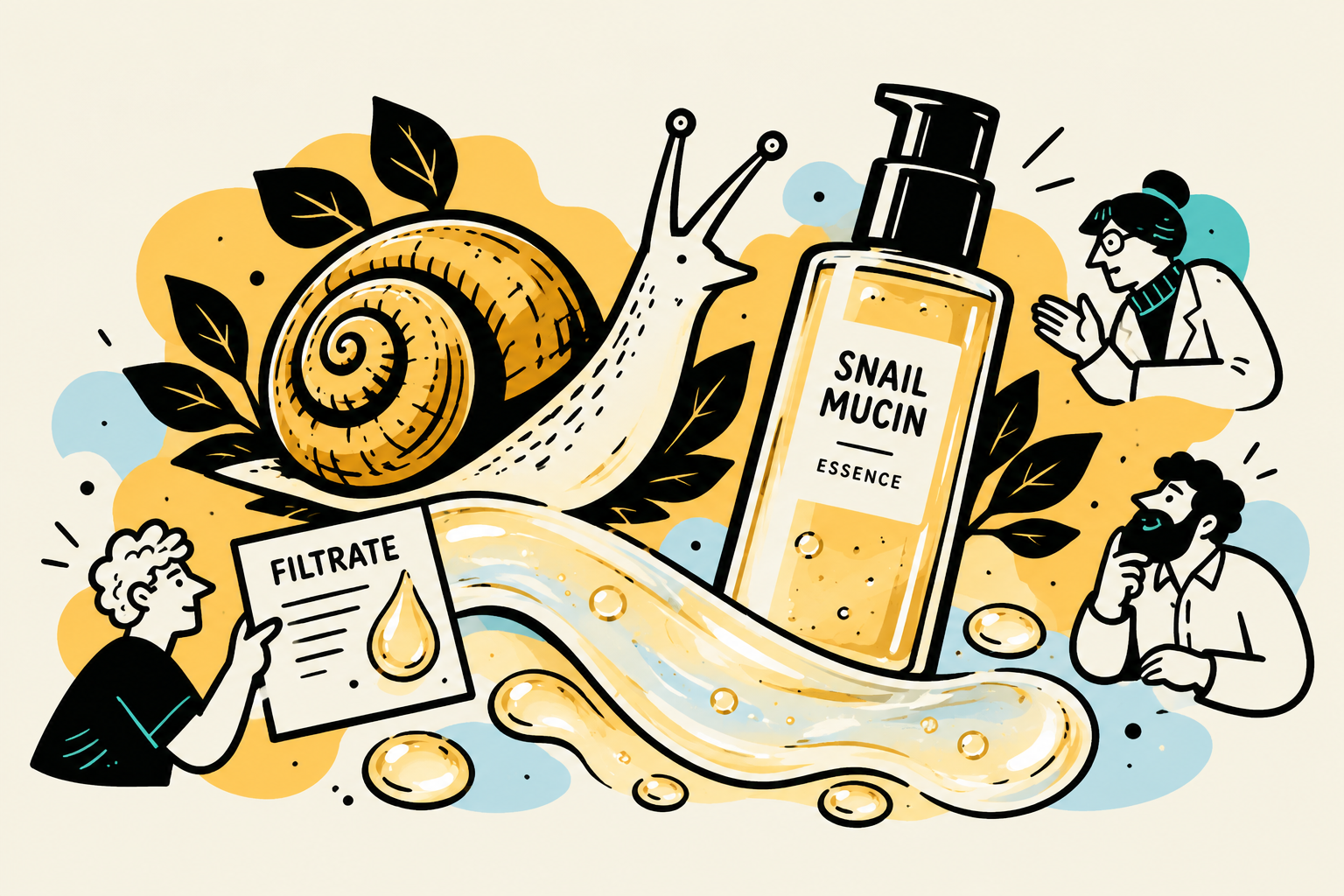
If you’ve spent more than five minutes browsing a K-beauty section, whether that’s a shelf at Olive Young in Myeongdong or a listing on a Korean skincare retailer site, you’ve almost certainly seen the word “mucin” staring back at you. Snail mucin (달팽이 점액여과물, dalpaengi jeomaek yeogwamul, literally “filtered snail secretion”) has been one of the most durable ingredients in Korean skincare for over a decade, and it shows no sign of disappearing from ingredient lists any time soon. This guide breaks down what snail mucin actually is, why Korean skincare culture embraced it so completely, and how to figure out if it deserves a spot in your own routine.
This article is general information, not medical advice. If you’re dealing with persistent acne, rosacea, eczema or another skin condition, please see a dermatologist.
Where Snail Mucin Actually Comes From
Snail mucin is the secretion produced by the Cornu aspersum (formerly Helix aspersa) garden snail, the same slimy trail you’d see on a sidewalk after rain. In cosmetic production, snails are placed in a stress-free, controlled environment (reputable Korean manufacturers like COSRX and CosRX’s suppliers emphasize “no-harm” collection methods, where snails are gently coaxed to secrete mucin onto a mesh surface rather than being harmed) and the resulting filtrate is collected, filtered, and stabilized for use in serums, essences, and creams.
The ingredient entered the Korean beauty market in a notable way in the mid-2000s, partly driven by a widely circulated story about Chilean snail farmers noticing smoother, faster-healing hands after handling snails for escargot export. Korean cosmetic chemists picked up on the anecdote and began formulating with snail secretion filtrate, and the ingredient found a particularly receptive audience in Korea’s skincare culture, which already prized “double hydration” and glass-skin-style dewiness.
What’s Actually Inside Snail Mucin
The filtrate is a complex mixture, and this complexity is part of why it works across several different skin concerns at once rather than doing just one job:
- Glycoproteins and hyaluronic acid. Draw and hold moisture in the skin, giving the immediate plumping effect people notice within days
- Glycolic acid. A mild alpha-hydroxy acid (AHA) present in small, gentle concentrations, offering light exfoliation
- Allantoin. A soothing, skin-protectant compound also used in diaper creams and wound-care products
- Copper peptides. Associated with collagen support and skin repair signaling
- Antimicrobial peptides. Part of what gives snail mucin its reputation for calming irritated or post-procedure skin
No single ingredient here is exotic on its own, but the natural combination and ratio found in snail secretion is difficult to replicate synthetically, which is part of the marketing appeal and, to be fair, part of the genuine formulation interest from Korean R&D labs like those behind COSRX and Mizon, two of the earliest major snail-mucin adopters.
Why It Became a Cornerstone of Korean Skincare Specifically
Korean skincare philosophy is built around layering multiple thin, hydrating products rather than one heavy moisturizer. The well-known 10-step routine (which we cover in a separate post) depends on ingredients that layer well without pilling or feeling heavy. Snail mucin essences and ampoules fit that philosophy almost perfectly: they’re typically lightweight, slightly tacky-then-absorbing textures that sit comfortably under 3-4 additional layers of product.
There’s also a cultural dimension. Korean beauty standards have long prioritized “glass skin” (a poreless, luminous, hydrated look) over the matte finishes historically popular in Western markets. Snail mucin’s humectant properties are extremely good at producing that dewy finish, which made it a natural fit for the aesthetic Korean consumers were already chasing before the ingredient went viral internationally around 2017-2019 via YouTube and Reddit’s r/AsianBeauty community.
Does the Science Actually Hold Up?
Independent research on snail secretion filtrate is more limited than research on ingredients like niacinamide or retinoids, but there is peer-reviewed support for several of its claimed benefits:
- A systematic review of 10 human clinical studies of snail-based products reported improvements in measures such as skin roughness, elasticity, hydration and wrinkles, but noted that many of the studies were small and lacked long-term follow-up.
- Allantoin, one of the filtrate’s key components, has decades of standalone safety and efficacy data as a soothing agent. It’s an FDA-approved skin-protectant ingredient in the US as well.
- The glycolic acid content is generally too low in most formulations to function as a true chemical exfoliant on its own, so don’t expect resurfacing results comparable to a dedicated AHA toner.
In short: the hydration and soothing claims are reasonably well supported; the “wrinkle-reversing” and “scar-erasing” claims that circulate on social media are overstated.
How Koreans Actually Use It (Not Just How It’s Marketed Abroad)
In Korean skincare routines, snail mucin products are rarely used as a “hero” standalone treatment the way Western marketing sometimes frames them. Instead, they typically show up in one of two roles:
- As an essence, applied after toner and before serum. This is the most traditional placement, since essences in Korean routines exist specifically to prep and hydrate skin before heavier actives.
- As a recovery product, used heavily after dermatologist visits involving lasers, chemical peels, or needling, Korean dermatology clinics in Gangnam’s famous “beauty belt” frequently recommend mucin-based creams for post-procedure calming, which is where a lot of the “healing” reputation actually originates.
Popular Korean Snail Mucin Products Worth Knowing
- COSRX Advanced Snail 96 Mucin Power Essence. The product most responsible for the ingredient’s global fame; contains 96% snail secretion filtrate
- Mizon Snail Repair Intensive Ampoule. A slightly older, more concentrated formulation popular in Korea before COSRX’s rise
- Some By Mi Snail Truecica Miracle Repair line. Combines mucin with Centella asiatica for a calming-focused formula
- Benton Snail Bee High Content Essence. Pairs mucin with bee venom for an anti-aging angle
Who Should (and Shouldn’t) Use Snail Mucin
Good candidates: dry, dehydrated, or irritated skin; post-procedure or post-sunburn skin needing calm; anyone building a layering-based routine who wants a lightweight hydration boost.
Proceed carefully: those with shellfish or mollusk allergies should patch-test first, since cross-reactivity, while uncommon, has been reported. Extremely oily or acne-prone skin types may find some snail mucin formulations slightly tacky or occlusive, though lighter essence formulas are usually fine.
How to Patch Test and Introduce It Safely
Even though snail mucin is considered low-risk, any new active deserves a proper patch test, especially given the shellfish/mollusk cross-reactivity concern mentioned above:
- Apply a small amount to the inner forearm or behind the ear.
- Wait 24-48 hours, checking for redness, itching, or bumps.
- If clear, introduce it into your routine at night only for the first week.
- Expand to twice daily once you’ve confirmed no sensitivity.
Korean skincare culture tends to be conservative about introducing new actives one at a time rather than overhauling a routine all at once, a habit worth borrowing regardless of which ingredient you’re testing.
Common Myths About Snail Mucin
Myth: “It’s tested on live, harmed snails.” Reputable Korean manufacturers use humane collection methods where snails are placed on mesh netting in a stress-free environment and mucin is gently collected without harm; the animals are returned to their habitat afterward. This isn’t universal across every brand worldwide, so if it matters to you, look for suppliers that are explicit about cruelty-free sourcing.
Myth: “Higher percentage always means better results.” A product boasting “96% snail mucin” isn’t automatically superior to one with 80%, since formulation, pH, and supporting ingredients matter as much as raw concentration. COSRX’s 96% figure became a marketing benchmark that other brands now compete against, but percentage alone doesn’t guarantee performance.
Myth: “It can replace sunscreen or retinoids.” Snail mucin is a supportive, hydrating ingredient. It has no meaningful SPF and is not a substitute for actives with strong clinical backing for anti-aging, like retinoids or vitamin C.
Snail Mucin vs. Hyaluronic Acid
Snail mucin is often compared to hyaluronic acid, since both are marketed for hydration. Here is how they actually differ.
The Core Difference
Hyaluronic acid is a single, well-defined humectant molecule. Its job is specifically to bind and hold water in the skin. Snail mucin, covered in depth in our dedicated post, is a complex natural secretion containing hyaluronic acid among many other components, including glycoproteins, allantoin, and copper peptides, giving it a broader, multi-functional profile rather than one narrow mechanism.
In short: hyaluronic acid is one ingredient with one primary job; snail mucin is a mixture that happens to include hyaluronic acid alongside several other active components.
Hydration Mechanism Compared
Both are humectants at their core, but:
- Hyaluronic acid works purely by attracting and holding water molecules, with different molecular weights (as covered in our Torriden Dive-In review) affecting how deeply it penetrates
- Snail mucin’s hydration comes from a combination of its own hyaluronic acid content plus glycoproteins that provide additional moisture-binding and slight occlusive properties, which is part of why snail mucin often feels slightly different on skin (a brief tacky stage) compared to a pure hyaluronic acid serum
Questions We Get Asked
Can I use snail mucin every day?
Yes. Most formulations are gentle enough for twice-daily use once you’ve patch tested successfully. It’s one of the few K-beauty actives without a strict “start slow” ramp-up period.
Can I layer snail mucin with retinol or vitamin C?
Generally yes. Its main role is hydration and barrier support, so it pairs well as a buffer layer either before a retinoid (to cushion irritation) or after vitamin C (to seal in the antioxidant serum).
Is snail mucin vegan?
No. Because it’s an animal-derived secretion, it isn’t considered vegan even when collection is cruelty-free. If you’re following a strict vegan skincare routine, look for plant-based “mucin alternatives” using fermented ingredients instead, which some newer Korean indie brands now offer.
Why does snail mucin feel sticky at first?
The glycoproteins that give it its hydrating power also create a temporary tacky sensation on application. This typically resolves within a minute or two as it absorbs. If it stays tacky longer than that, you may be using too much product, or your next layer needs to go on sooner.
What to Remember
Snail mucin isn’t a miracle ingredient, but it’s also not just a marketing gimmick. It’s a well-rounded hydrating and soothing ingredient that happens to fit Korean layering routines exceptionally well, which is the real reason it became such a fixture rather than any single dramatic before-and-after result. If your skin leans dry, sensitive, or dehydrated, it’s one of the more evidence-backed K-beauty ingredients worth trying, especially as a mid-routine essence rather than a stand-alone miracle cure.
Read Next
What’s Actually in a Korean Cleansing Oil? Ingredients Explained
Cleansing oils look deceptively simple on the ingredient label, often just a handful of oil…
Retinol vs. Retinal vs. Bakuchiol: Korean Anti-Aging Actives Compared
Anti-aging ingredient choice has gotten more complicated in recent years as retinal and bakuchiol have…
What Is Cica? Centella Asiatica Meaning, Benefits, and How to Use It
If snail mucin was the ingredient that introduced the world to K-beauty in the late…
Pure Vitamin C vs. Derivatives: Which One Is in Your Brightening Serum?
Two serums both say vitamin C on the front. One stings slightly, comes in an…
Peptides in Korean Skincare: What They Actually Do
Peptides occupy an interesting middle ground in Korean skincare, widely used in anti-aging formulations, frequently…
What Does “Hanbang” Mean in Korean Skincare?
“Hanbang” appears constantly in Korean skincare marketing (printed on packaging, used in brand descriptions, referenced…