How to Read a Korean Skincare Ingredient List (And Spot a Fake Hero Ingredient)
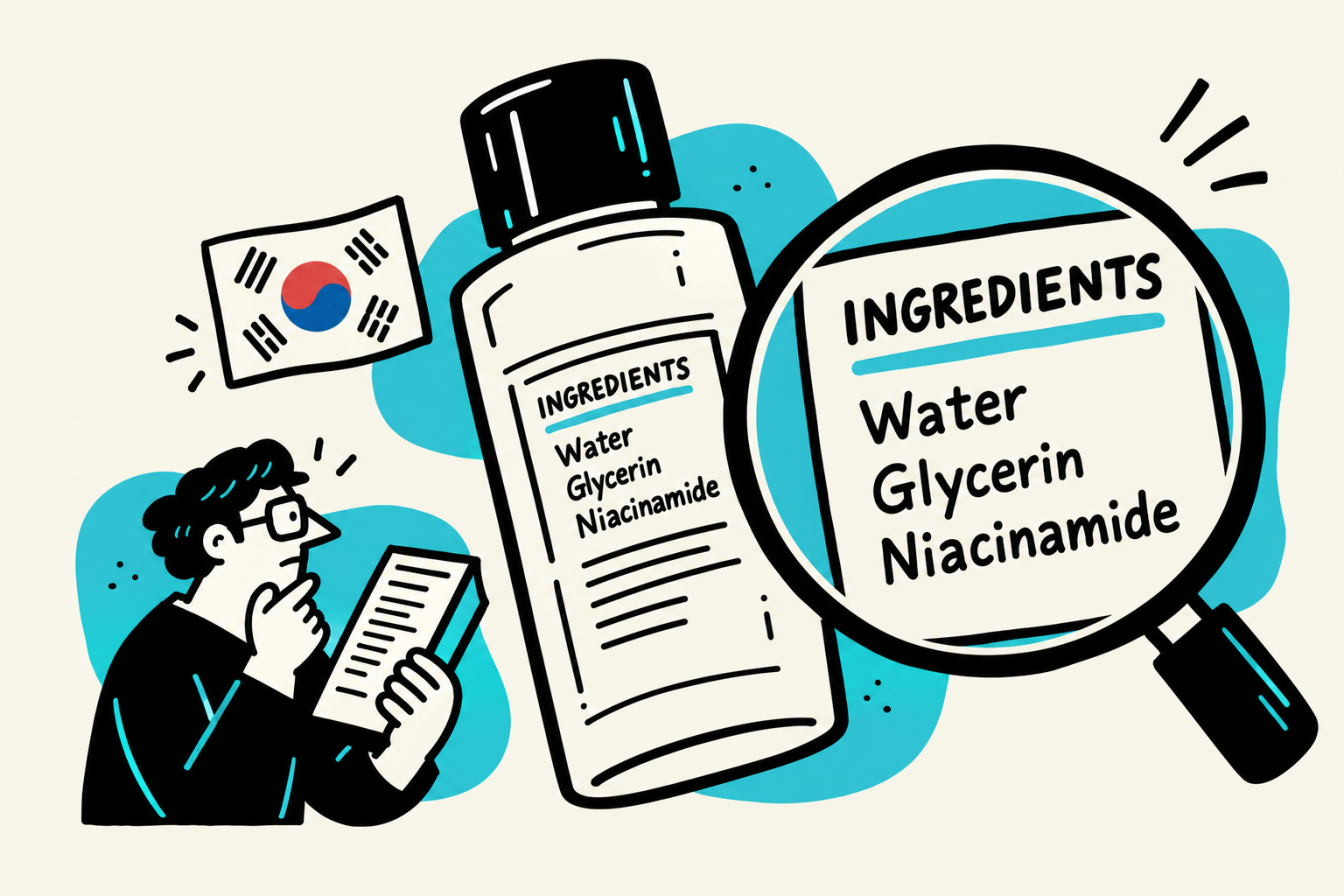
A serum named after an ingredient does not have to contain much of it. That sentence took me an embarrassingly long time to internalise, and once I did, a lot of my earlier purchases made retrospective sense: the products that did nothing were frequently the ones whose entire identity was a single word on the front of the bottle.
This is the first in a series where I turn bottles over and read the back. The point is not to catch brands out, and plenty of the products involved are perfectly good. The point is that the front of a bottle is marketing and the back is disclosure, and the two are allowed to disagree.
How an Ingredient List Is Actually Ordered
Ingredients are listed in descending order of concentration, but only down to 1%. Below that threshold, a brand can list the remaining ingredients in any order it likes. That single rule explains most of what looks like deception on a label.
It means the top of the list is reliable and the bottom is not. If water, glycerin and butylene glycol open a list, that is genuinely what the product mostly is. If your hero ingredient appears fourteenth, sandwiched between a preservative and a fragrance component, you have learned that it is present at well under 1% and nothing more precise than that.
The useful trick is to find the 1% line yourself. Preservatives such as phenoxyethanol, thickeners like carbomer and xanthan gum, and chelators like disodium EDTA are almost always used below 1%. Wherever the first of those appears, everything after it is in the unordered zone.
The Hero Ingredient Trick
The pattern repeats across categories. A product is named for an ingredient, the packaging is designed around it, the product description talks about little else, and on the back it sits below the preservative. This is legal, common, and usually not even dishonest in a narrow sense: the ingredient is in there.
Where it costs you is in diagnosis. You try a peptide serum, see nothing in eight weeks, and conclude that peptides do not work on your skin. The product you tested may have contained only a small amount of peptide, in which case the result tells you little about peptides in general.
Two clues that a name is doing the heavy lifting rather than the formula. First, the front says the ingredient but gives no percentage anywhere on the packaging; brands that have invested in a meaningful dose often print the number, though not all of them do. Second, the list is very long. A thirty-five ingredient formula with your active near the bottom is usually a base formula with a small amount of the active. Whether that is enough depends on the ingredient, because some, such as peptides or retinoids, are used at low percentages on purpose.
Extract, Water, or Isolated Compound
Even at the top of the list, the same plant name can mean quite different things, and this is where percentages get genuinely misleading.
| What it says | What it is | How much to trust the number |
|---|---|---|
| Plant water or leaf water | Mostly water, with a small amount of plant material | A high percentage here is mostly a high percentage of water |
| Plant extract | Concentrated, but the concentration itself is not disclosed | Meaningful, but not comparable between brands |
| Isolated compound (e.g. madecassoside) | The specific molecule the research is about | The most informative, and usually the most expensive |
A toner advertising “77% heartleaf” and one advertising “5% heartleaf extract” are not on the same scale at all, and the one with the smaller number may well be delivering more of the active material. I worked through a version of this in the post on what cica actually means on a label, where the same plant appears in all three forms depending on the price of the product.
Where Korea Makes This Easier
Korean regulation helps in one specific place. Products making certain claims, such as anti-wrinkle, brightening or sun protection, fall under a separate functional-cosmetics designation, and that route requires the active and its concentration to be substantiated rather than merely implied.
In practice this means a claim like “anti-wrinkle” on a Korean product is carrying more weight than the same word on an unregulated one, because there is a specific approved ingredient behind it at a specific dose. It does not mean the product is good. It means the number is real. I go through how that designation works in the guide to Korea’s functional cosmetics label.
Everything outside that system, which is most of what fills a shelf, is back to the ordinary rules. Hydrating, soothing, glowing and revitalising are not regulated claims and require no particular dose of anything.
The Thirty-Second Check
This is what I actually do standing in a shop, and it is not sophisticated.
- Find the hero ingredient in the list. If it is not in the first five or six, lower your expectations. This is only a rough rule of thumb: list position tells you the relative amount, not how well the product works, and some ingredients, such as retinoids or peptides, are used at very low percentages on purpose.
- Find the first preservative or thickener. Anything below it is generally present in small amounts.
- Check for a printed percentage anywhere. Its absence on a product named after an ingredient is informative.
- Check the form. Water, extract, or named compound, as above.
- Count the list. Very long lists often mean each ingredient is present in small amounts, though that alone does not make a product ineffective; very short ones are easier to evaluate, though a short list is not proof of quality.
Five steps, and it has saved me more money than any amount of reading reviews. Reviews tell you how a product felt for someone else. The back of the bottle tells you what you are buying.
Quick Questions
Does a low position always mean the ingredient is useless?
No, and this is the main caveat. Some actives work at very low concentrations, and some ingredients are genuinely only needed in trace amounts. Retinoids and certain peptides do real work well under 1%. The rule is about calibrating expectations for ingredients that need volume, such as humectants, oils and soothing extracts.
Is a shorter ingredient list better?
Usually simpler, not automatically better. A short list is easier to evaluate and easier to blame when something goes wrong, which is genuinely useful if you react to things. But a well-built thirty-ingredient formula can outperform a poorly built ten-ingredient one.
Why do brands print percentages sometimes and not others?
Because it is a selling point when the number is good and a liability when it is not. Treat a printed percentage as a signal of confidence, and check what form the ingredient is in before being impressed by the size of it.
Where do I find the full list for something I am buying online?
Retailer pages are often abbreviated or out of date. The brand’s own product page is better, and for Korean products the listing on the Korean site is frequently more complete than the English one.
Wrapping Up
None of this requires chemistry. It requires knowing that the list is ordered, that the order stops meaning anything below 1%, and that the same plant name can describe three quite different things.
Next in this series I will take a specific product that has been the subject of an ongoing argument about whether its headline ingredient is really what the label implies, and go through it line by line. The short version is that the number on the front was never the interesting part.
Read Next
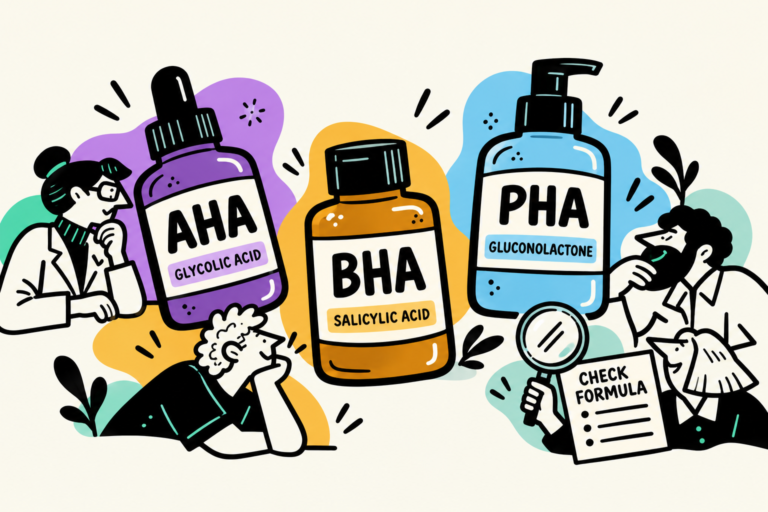
PHA vs AHA vs BHA: A Beginner’s Guide to Chemical Exfoliants
AHA, BHA and PHA are families of exfoliating ingredients. The useful comparison is the concern…
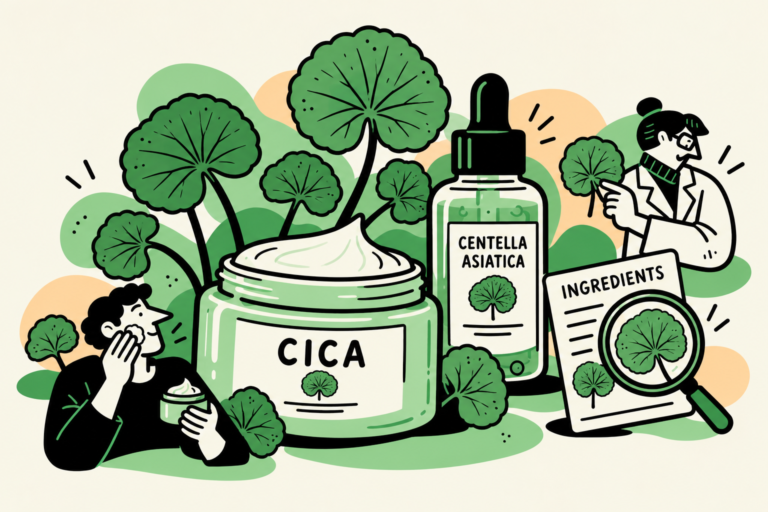
What Is Cica? Centella Asiatica Meaning, Benefits, and How to Use It
If snail mucin was the ingredient that introduced the world to K-beauty in the late…
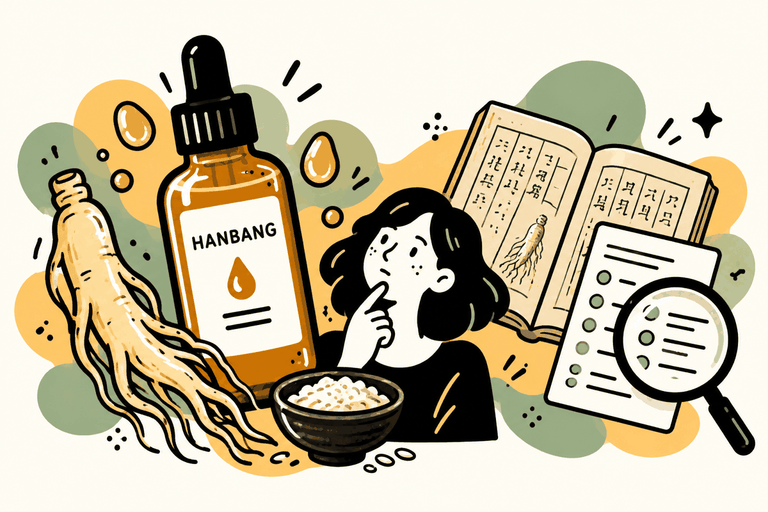
What Does “Hanbang” Mean in Korean Skincare?
“Hanbang” appears constantly in Korean skincare marketing (printed on packaging, used in brand descriptions, referenced…
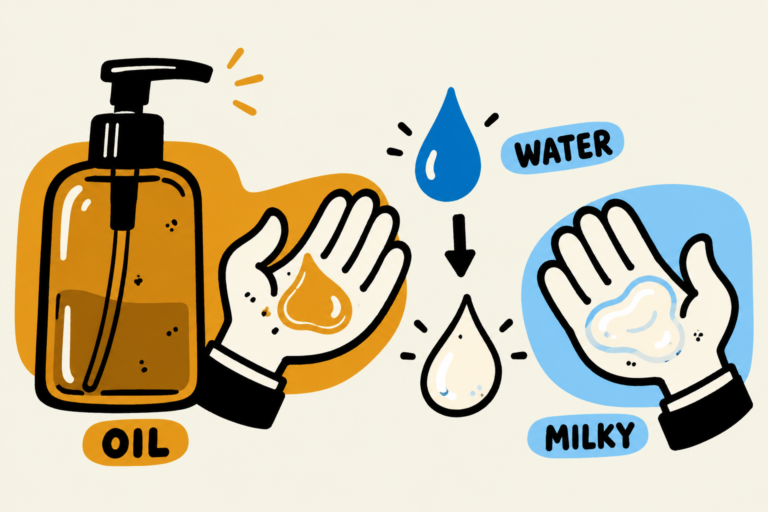
What Does “Emulsify” Mean in Skincare? A Cleansing Oil Explainer
In cleansing-oil instructions, “emulsify” means adding water and gently working it through the cleanser so…
What Is Snail Mucin and Why Is It in Every K-Beauty Product?
If you’ve spent more than five minutes browsing a K-beauty section, whether that’s a shelf…
Retinol vs. Retinal vs. Bakuchiol: Korean Anti-Aging Actives Compared
Anti-aging ingredient choice has gotten more complicated in recent years as retinal and bakuchiol have…