The Niacinamide + Zinc Combo Behind a Simple, Repeatable Morning Routine
During my military service in Korea, the basic steps of my evening routine stayed the same, but the actives in my serum slot changed constantly. Different actives, different weeks, whatever my skin was doing. My morning routine barely moved the whole time, and that was deliberate: mornings are when I am least likely to make a good decision, and the point of a morning routine is that it survives being done badly at six a.m.
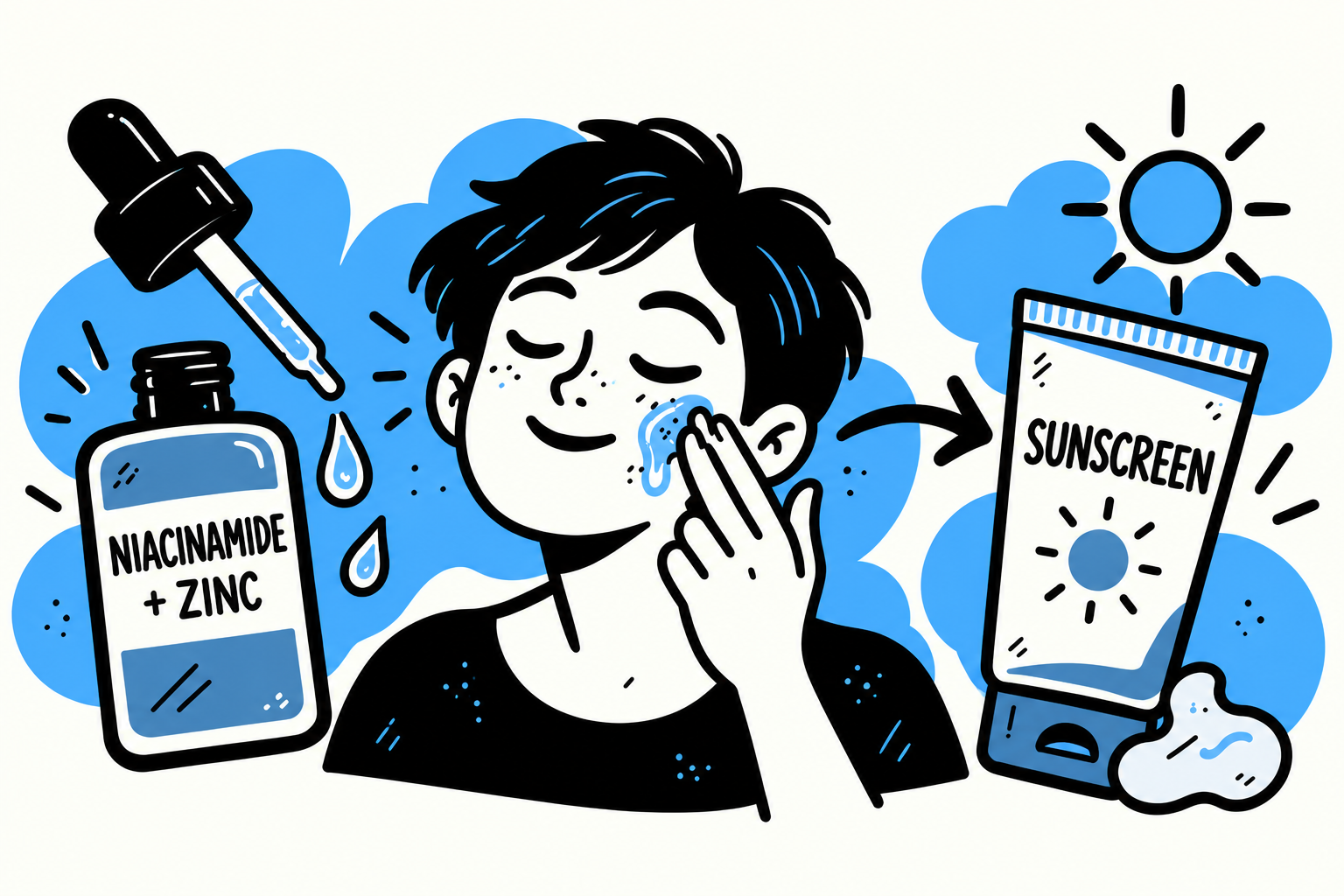
The one active that stayed in it was niacinamide paired with zinc. Not because it is dramatic, but because it is the rare combination that does something useful every single day without needing to be scheduled around anything else.
What Niacinamide and Zinc Each Do
Niacinamide is a form of vitamin B3 that helps skin build the lipids in its own barrier, moderates oil production, and reduces the look of post-inflammatory marks over time. It is one of very few ingredients that is simultaneously well evidenced, tolerated by most skin types, and cheap.
Zinc, usually as zinc PCA in these formulas, is an oil-regulating and calming addition. It works on the sebum side of the problem and brings mild soothing with it. On its own it is unremarkable. Next to niacinamide it covers the same target from a second angle, which is why the two so often appear in one bottle.
The honest framing: niacinamide is the active, zinc is the support. If you find a formula you like that omits the zinc, you have not lost much. If you find one with zinc and no niacinamide, you have.
Why This Pair Suits the Morning Specifically
Most of the ingredients people care about belong at night. Retinoids and acids are light-sensitive, irritating, or both, and they need a clear run at skin that is not about to be exposed to sunlight for ten hours. That leaves the morning slot looking empty, and a lot of people fill it with nothing but sunscreen.
Niacinamide is the obvious candidate for that slot because none of those constraints apply. It is stable in light, it does not increase photosensitivity, it is generally well tolerated at moderate strengths (higher percentages are more likely to cause flushing or stinging, as noted below), and it layers under sunscreen without pilling if you give it a minute. The oil-control side is also more useful in the morning than at night, since the hours it is working are the hours your face is shiny.
There is a second, less obvious reason. Because it is boring, you will actually do it. An active you use four mornings out of seven does less than one you use seven mornings out of seven, and consistency is doing more of the work here than potency.
The Concentration Question
Serums land in roughly three bands, and higher is not better.
| Concentration | What it is for | Notes |
|---|---|---|
| 2 to 4% | Barrier support, sensitive skin, first exposure | Common inside moisturisers rather than as a standalone serum |
| 5% | The general-purpose choice | Where most of the research sits; what I used daily |
| 10% and above | Oil control on resilient skin | More likely to flush or sting; no clear added benefit for most people |
During my military service in Korea, I moved down from 10% to 5% after a stretch of mild flushing that I had assumed was unrelated, and nothing about my skin got worse. That is the usual experience. The 10% formulas exist because a number on a box sells, not because the extra five points are doing something the first five did not.
What to Layer It With
Niacinamide is unusually easy to place. It sits happily with hydrating toners, peptides, centella, and every sunscreen I have tried. The layering order is the ordinary one: toner, then the serum, then moisturiser, then sunscreen.
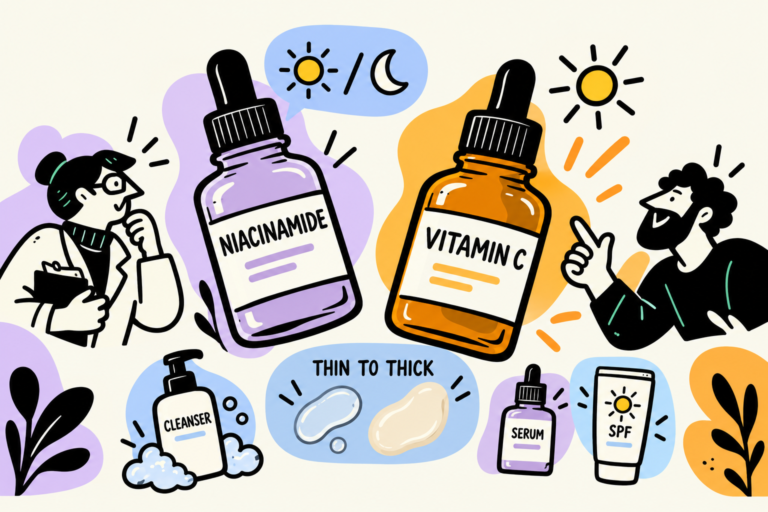
The one pairing worth thinking about is vitamin C. You will read that the two cannot be used together; that claim comes from decades-old research on raw niacin under heat, and it does not describe modern formulations. In practice they coexist fine. What I do not love is the texture of a vitamin C serum under a niacinamide serum under sunscreen, which is three layers competing for the same minute, so I keep vitamin C for days when I am not in a hurry.
The genuine constraint is weight rather than chemistry. A niacinamide serum is a light-to-medium layer, and if your moisturiser is already rich, adding it can tip the morning into something that never quite dries down. That is a texture problem with a texture solution, which I go through in the post on choosing skincare by moisture weight.
My Actual Morning, Start to Finish
- Rinse with water only, or a mild cleanser if I used a heavy cream the night before.
- Hydrating toner, pressed in with hands rather than a cotton pad.
- Niacinamide 5% with zinc, three or four drops, while the toner is still slightly damp.
- Wait a minute. This is the step everyone skips and the one that prevents pilling.
- Light moisturiser, then sunscreen, generously.
Four minutes, five products, no decisions. The sunscreen is the step doing the most work of the five, and if you are choosing one, the comparison of physical and chemical filters is the more consequential read.
Who Should Skip It
Niacinamide is well tolerated, but “well tolerated” is not “universal”. Some people flush, particularly at higher percentages, and a smaller group get a prickling sensation that does not settle with time. If that is you after a fair trial at 5%, there is no benefit in persisting; it is not an ingredient that requires the skin to adapt.
If your barrier is currently compromised, hold off on adding anything new at all until it has settled. And if your main concern is dryness rather than oil or marks, this pair is not aimed at you. It is a regulating combination, not a hydrating one.
Quick Questions
How long before I see anything?
Oil control is the fastest and shows in two to four weeks. Marks and tone even out far more slowly, on the order of three months, and only if sunscreen is being used properly alongside. Anything promising faster than that on pigmentation is selling something.
Morning or night?
Either works. I used it in the morning because my nights were occupied by actives that could not move, not because niacinamide is somehow a daytime ingredient. If your evenings are free and your mornings are rushed, flip it.
Do I need a serum if my moisturiser already has it?
Often not. Plenty of moisturisers carry 2 to 4%, which is a reasonable dose. Check where it sits on the ingredient list; if it is listed below the fragrance, it is probably present in a small amount, though list position alone cannot tell you how well the product works.
Is zinc PCA the same as the zinc in sunscreen?
No. Zinc oxide in sunscreen is a mineral UV filter that sits on the surface and blocks light. Zinc PCA is a soluble salt used inside the formula for oil regulation. Same element, entirely different job.
Wrapping Up
There is nothing exciting about this combination, and that is the argument for it. It works at a modest concentration, it conflicts with almost nothing, it costs very little, and it asks for no scheduling. Those four properties are what make an active survive contact with a real morning.
If you are building a morning routine from scratch, sunscreen first, a hydrating layer second, and this third. Everything past that is optimisation, and optimisation is what gets abandoned by week three.
Read Next
Retinol vs. Retinal vs. Bakuchiol: Korean Anti-Aging Actives Compared
Anti-aging ingredient choice has gotten more complicated in recent years as retinal and bakuchiol have…
The Azelaic Acid pH Controversy: What It Actually Proves (And What It Does Not)
This is the second post in a series about reading what is actually in a…
PHA vs AHA vs BHA: A Beginner’s Guide to Chemical Exfoliants
AHA, BHA and PHA are families of exfoliating ingredients. The useful comparison is the concern…
What Is Snail Mucin and Why Is It in Every K-Beauty Product?
If you’ve spent more than five minutes browsing a K-beauty section, whether that’s a shelf…
Adenosine: Korea’s Officially Approved Anti-Wrinkle Ingredient
Adenosine occupies a unique regulatory position in Korean skincare that most international shoppers never realize:…
Niacinamide vs Vitamin C: Which Should You Use First in Your Routine?
Walk into any Olive Young store in Korea and you’ll find entire endcaps dedicated to…