The 10-Step Korean Skincare Routine, Explained Simply (and the 3 Steps I Actually Use)
The “10-step Korean skincare routine” is probably the single most famous export of K-beauty culture, and also one of the most misunderstood. Many people assume it means applying ten different products every single day, which isn’t quite accurate and has scared off plenty of beginners before they even start. Here’s what the routine actually is, where it came from, and how to realistically build your own version.
This article is general information, not medical advice. If you’re dealing with persistent acne, rosacea, eczema or another skin condition, please see a dermatologist.
Key takeaways
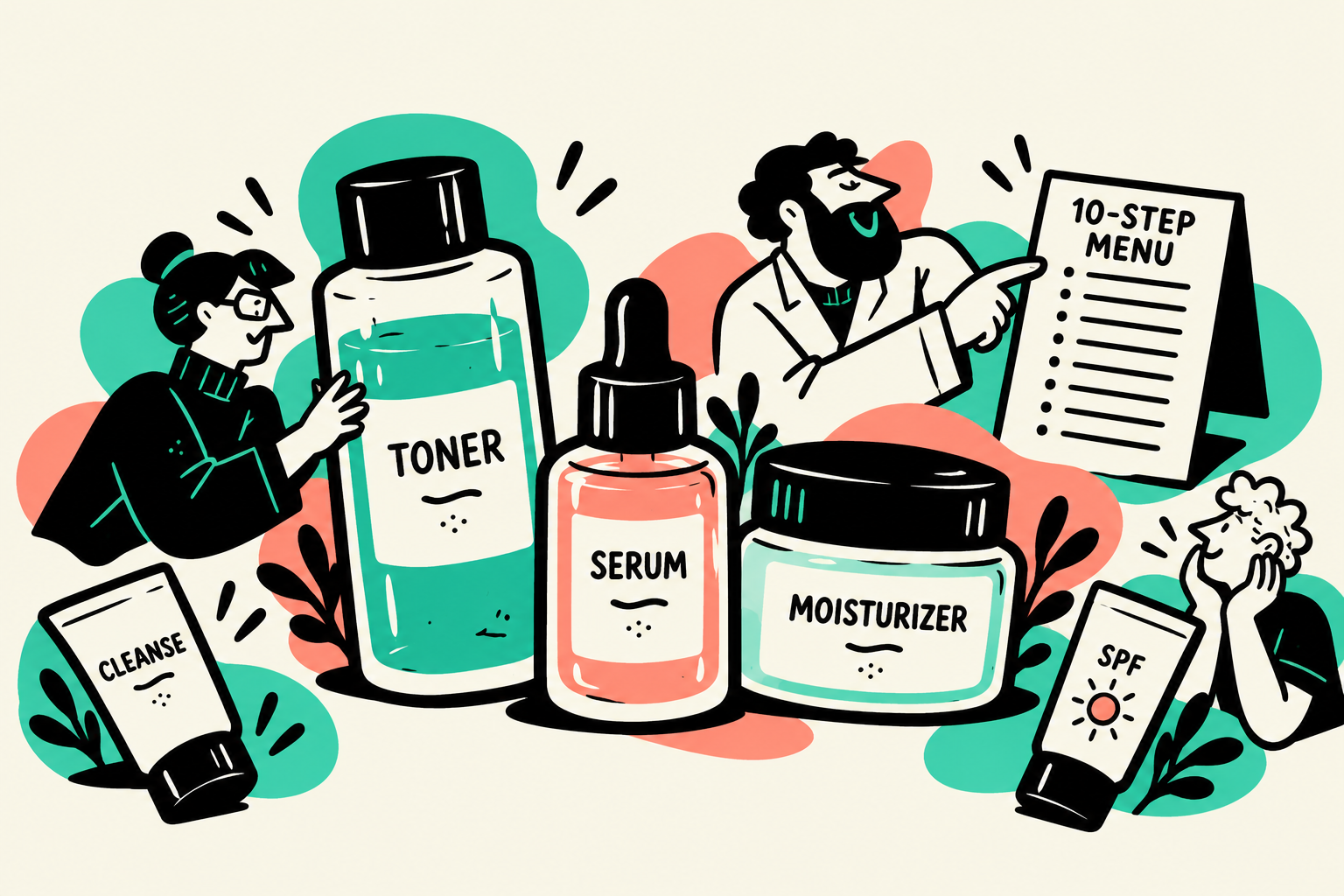
The 10-step routine is best understood as a menu, not a mandate, a framework describing the full philosophy of Korean layered, preventive skincare rather than a strict daily checklist. Most people, including many Koreans, use a simplified core version most days and reserve the full sequence for more intensive routine sessions.
For a real-life example: I’m Korean, and my own daily routine during my military service in Korea was just three steps. It’s laid out further down.
Where the “10 Steps” Concept Came From
The 10-step routine isn’t an ancient tradition. It’s a relatively modern marketing framework, largely credited to Charlotte Cho, co-founder of Soko Glam, who popularized the concept for Western audiences around 2012-2015 by codifying observations from real Korean skincare habits into a clean, teachable structure. Korean consumers themselves don’t typically think of their routines in terms of “10 steps”. The concept is more accurately described as Korean skincare’s underlying philosophy of thorough, layered, preventive care, formalized into a marketable number for international audiences.
That said, the philosophy behind it is Korean and reflects real cultural priorities: an emphasis on hydration through layering multiple lightweight products rather than one heavy one, thorough double cleansing, and treating sun protection and prevention as more important than aggressive treatment after damage occurs.
The 10 Steps, In Order
1. Oil Cleanser
Removes makeup, sunscreen, and oil-based impurities. This is the first half of the “double cleanse” method, based on the principle that oil dissolves oil more effectively than water-based cleansers alone.
2. Water-Based Cleanser
Follows the oil cleanser to remove water-based impurities like sweat and leftover residue, and to clean the skin itself (rather than just what’s on top of it). Korean cleansers in this step are typically low-pH (around 5.5, matching skin’s natural pH) to avoid disrupting the skin barrier, a formulation detail Korean brands emphasize far more explicitly than most Western cleanser brands.
3. Exfoliator
Used 2-3 times weekly rather than daily, using either a gentle physical exfoliator or, more commonly in modern Korean routines, a chemical exfoliant toner (AHA/BHA/PHA, covered in a separate post).
4. Toner
In Korean routines, toner isn’t the astringent, alcohol-based product it’s sometimes associated with in Western drugstores. It’s a hydrating first layer meant to rebalance the skin’s pH after cleansing and prep it to better absorb everything that follows.
5. Essence
Often the step that confuses newcomers most, since it doesn’t have a clean Western equivalent. Essence is a lightweight, watery product that sits between toner and serum in both texture and function. It is hydrating, slightly more active than toner, and specifically designed to boost how well subsequent layers absorb. This step is considered central to Korean skincare philosophy; the essence step is where products like the original SK-II Facial Treatment Essence or COSRX’s Snail Mucin Essence typically sit.
6. Treatment/Serum/Ampoule
This is where targeted active ingredients live, such as vitamin C, niacinamide, peptides, or other concentrated treatments addressing specific concerns like brightening, fine lines, or acne.
7. Sheet Mask
Used a few times a week rather than daily for most people, sheet masks deliver a concentrated dose of serum-like essence directly against the skin for 15-20 minutes. Korea’s sheet mask culture is enormous. Convenience stores sell them individually, and it’s common for Koreans to sheet mask several times a week as a routine habit rather than a special occasion.
8. Eye Cream
A dedicated, lighter-weight product for the thinner, more delicate skin around the eyes, targeting concerns like fine lines, puffiness, and dark circles.
9. Moisturizer
The step that locks in everything applied beneath it, typically chosen based on skin type, such as lighter gel-creams for oily/combination skin, richer creams for dry skin.
10. Sunscreen (AM only)
The non-negotiable final step of any morning routine. Korean sunscreens are famous internationally for their light, cosmetically elegant textures compared to many Western SPF formulas, which is part of why brands like Beauty of Joseon and Round Lab built huge followings specifically around their sunscreen lines.
Do You Actually Need All 10 Steps Every Day?
No, and most Koreans themselves don’t follow all 10 steps daily. In practice:
- Double cleansing is typically an evening habit. It is most useful when you wore makeup or a long-wear or water-resistant sunscreen, and optional on lighter days or when your skin is irritated.
- Exfoliation is 2-4 times weekly.
- Sheet masks are usually 2-3 times weekly, sometimes as a relaxing evening ritual rather than a strict routine step.
- Toner, essence, serum, moisturizer, sunscreen form the more consistent daily “core”, often closer to 5-6 steps on an ordinary day.
The full 10-step version tends to show up more as a special, intensive weekend routine or a response to a specific skin concern needing extra attention, not a daily obligation.
A Simplified Beginner Version
If 10 steps feels overwhelming, a reasonable starting point that still reflects Korean skincare philosophy is:
- Cleanser (double cleanse when needed for makeup or water-resistant sunscreen; otherwise, a single gentle cleanse may be sufficient)
- Toner
- Serum (pick one active based on your main concern)
- Moisturizer
- Sunscreen (AM)
This “5-step” simplified structure is increasingly common in Korea itself, reflecting a real shift toward what’s locally called “skinimalism” or minimalist routines, particularly among younger consumers who find the full 10-step approach too time-consuming for daily life.
What I Actually Use: A Korean Editor’s 3-Step Routine
I grew up in Korea, and I did not use ten steps. During my military service, my routine used the same steps every day: a toner, then one ampoule or serum, then a moisturizer. Cleansing comes before it, and sunscreen goes on top in the morning. My skin is slightly oily and sensitive, and I’ve found that a short, fixed routine is easier to keep up and makes it much clearer which product is doing what.
When I try something new, it goes into its usual slot and I use it for about four weeks before deciding whether it stays. Since moving to Australia my routine has changed, and I describe that in my barrier recovery diary. These are products I’ve used this way:
| Step | Products I have used | What I noticed |
|---|---|---|
| Toner | Round Lab Birch Juice Moisturizing Toner | Closer to a first essence than a splash toner; slightly slippery, then absorbs with no oiliness |
| Toner slot (alternative) | COSRX The 6 Peptide Skin Booster | Light and watery; I layer it twice. Smoother, more moisturized skin, with gradual rather than dramatic change |
| Ampoule / serum | Torriden Dive-In Low Molecule Hyaluronic Acid Serum | Absorbs quickly with no sticky finish; the easiest all-rounder of the hydrating serums I compared |
| Moisturizer | Round Lab 1025 Dokdo Lotion | Light, leaves a thin protective layer; the best value of the Round Lab products I tried |
| Sunscreen (AM) | Round Lab Birch Juice Moisturizing Sun Cream | Goes on like a moisturizer, with no eye sting or burning |
Not everything worked. Torriden’s Dive-In Watery Moisture Sun Cream left my skin hot and flushed, which is exactly why I add new products into a routine I already know well. If something reacts, it’s obvious what caused it. You can read the full notes in my Torriden Dive-In review and Round Lab Birch Juice review.
That’s the practical takeaway from the 10-step idea: the order matters more than the number of products. Thinnest to thickest, one product per job, and sunscreen every morning will cover most of what the full routine is trying to do.
Common Mistakes When Building a 10-Step Routine
- Applying products in the wrong order. The general rule is thinnest/most watery to thickest/most occlusive. Applying a thick cream before a watery essence blocks the essence from absorbing properly.
- Introducing too many new products at once. Korean skincare culture favors adding one new product at a time and monitoring for a week or two before adding another, specifically to identify what’s causing any reaction if one occurs.
- Skipping sunscreen because “it’s cloudy” or “I’m indoors.” Korean dermatologists and skincare educators are notably insistent that UV exposure through windows and on cloudy days is still significant enough to warrant daily SPF.
- Over-exfoliating because more than one product in the routine contains an acid. Check ingredient lists across your toner, serum, and treatment products. It’s easy to accidentally stack multiple acids without realizing it.
The Opposite Approach: Skin Streaming
Not everyone wants ten steps. The recent “skin streaming” trend goes the other way, cutting a routine down to a few multitasking products. Here is how it compares.
What “Skin Streaming” Actually Means
Skin streaming refers to condensing a routine down to 3-4 essential steps, cutting out the additional layering categories (essence, ampoule, multiple serums) in favor of a leaner, more targeted approach, a direct response to “skin fatigue” from managing too many active ingredients and products at once.
A Reasonable Skin-Streaming Routine
- Gentle cleanser
- Treatment serum (targeted to your main concern)
- Moisturizer
- Sunscreen (AM)
This four-step core captures most of what a full routine accomplishes, with toner as an optional fifth addition for those who want the pH-rebalancing and hydration-layering benefit.
A Few More Questions
Do Koreans really do 10 steps every day? Most don’t. The full sequence is better known abroad than it is as a daily habit in Korea. Many people, me included, use three to five steps on an ordinary day and add extras like sheet masks or exfoliation a few times a week.
How long does a full 10-step routine take? Realistically 15-20 minutes once you’re familiar with the products, though many people extend it as a relaxing ritual rather than rushing through it.
Is the 10-step routine only for people with skin problems? No. It’s built around a preventive, maintenance-focused philosophy rather than treating existing problems, which is part of why it’s popular even among people with generally healthy skin.
Do men in Korea follow the 10-step routine too? Korean men’s skincare culture is notably more developed than in many Western markets. Korea has one of the highest rates of men’s skincare product usage globally, and simplified 3-5 step routines (cleanser, toner, essence, moisturizer, sunscreen) are common and not considered unusual.
What’s the difference between essence and serum if they seem similar? Essence is typically thinner, more hydration-focused, and used earlier in the routine to prep skin; serum is usually thicker and more concentrated with a specific active ingredient, used to target a defined concern. The line between them is blurry and inconsistent across brands.
Read Next
How Many Actives Is Too Many? A Simple Rule for Layering
There is a stage in most people’s skincare that I think of as the accumulation…
Choosing Skincare by Moisture Weight, Not Marketing Claims
Why the real reason a product does or does not work for your skin often comes down to a simple 1-to-3 moisture-weight mismatch, not the ingredient list.
How to Repair a Damaged Skin Barrier: A Korean-Style Recovery Routine
“피부장벽” (pibu jangbyeok, “skin barrier”) is one of the most frequently used terms in Korean…
Korean Skincare for Rosacea: What Helps, What Flares, and What to Skip
Sensitive skin reacts more readily to products, weather and touch than average skin, so every…
Morning vs Night K-Beauty Routine: What’s the Difference?
A lot of beginners assume a Korean skincare routine is identical morning and night, just…
I Over-Exfoliated With a Glycolic Acid Toner: My Barrier Recovery Diary (Part 1)
In April a 7% glycolic acid toner left my cheeks red and bumpy within a week. Five months on, here is everything I have tried, what did and did not help, and the barrier routine I use now.