What’s Actually in a Korean Cleansing Oil? Ingredients Explained

Cleansing oils look deceptively simple on the ingredient label, often just a handful of oil sources plus an emulsifier, but understanding what’s actually doing the work helps explain why some formulas feel dramatically different from others.
The Two Core Ingredient Categories
Every effective cleansing oil relies on two functional components working together:
- Oil sources. The actual dissolving agents that break down makeup, sunscreen, and sebum
- Emulsifiers. Ingredients that allow the oil to mix with water during rinsing, rather than leaving a greasy film behind
Common Oil Sources in Korean Cleansing Oils
- Sunflower seed oil. A common, gentle, widely-tolerated base oil
- Olive oil. Traditional, though heavier and occasionally less suited to acne-prone skin
- Jojoba oil. Technically a liquid wax, prized for closely mimicking skin’s natural sebum
- Rice bran oil. Reflects the broader hanbang-inspired ingredient trend, offering mild antioxidant properties alongside cleansing function
Why Emulsifiers Matter So Much
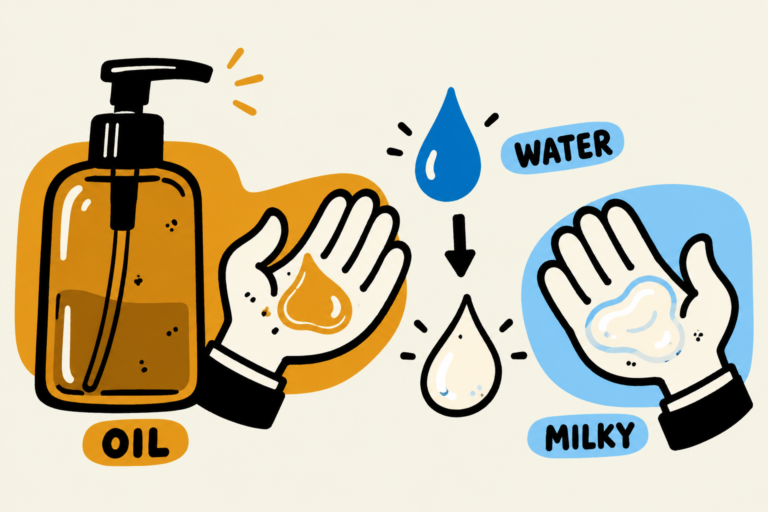
Without an effective emulsifier, an oil cleanser simply wouldn’t rinse away cleanly, leaving a greasy residue that defeats the purpose of cleansing in the first place. This emulsifying technology is one of the more important formulation differentiators between cleansing oils. A well-emulsifying formula turns milky and rinses cleanly, while a poorly formulated one can feel like it’s not fully coming off.
Does “Natural” or “Plant-Derived” Mean Better?
Not necessarily. A well-formulated synthetic emulsifier system can perform more reliably and consistently than some natural alternatives, and “natural” oil sources aren’t automatically less likely to cause breakouts or irritation. Formulation quality matters more than whether an ingredient is naturally or synthetically derived.
Ingredients Worth Watching For Sensitive or Acne-Prone Skin
- Comedogenic oils (like coconut oil in high concentrations) can be more likely to clog pores for acne-prone skin, though individual tolerance varies significantly
- Added fragrance, common in many cleansing oils for a pleasant sensory experience, is worth avoiding for sensitive or reactive skin
- Essential oils, sometimes included for scent, carry a higher irritation and allergy risk than synthetic fragrance for some users
How to Read a Cleansing Oil Ingredient List
Ingredients are listed in descending order by concentration, so the first few listed oils and emulsifiers make up the bulk of the formula. A short list with recognizable base oils near the top is generally a good sign of a straightforward, quality formulation.
Other Ingredients You Will See on the Label
Beyond the base oils and emulsifiers, a cleansing oil label usually includes a few supporting ingredients:
- Light ester oils such as caprylic/capric triglyceride: these give a silkier, less greasy feel than heavy plant oils and help dissolve makeup.
- Mineral oil or similar hydrocarbons: used in many cleansing oils because they dissolve sunscreen and makeup well and rinse off easily. Some people avoid them for personal reasons, but they are a standard cosmetic ingredient.
- Tocopherol (vitamin E): added mainly to slow the oils from going rancid, with antioxidant benefits as a bonus.
- Fragrance or essential oils: appear in some formulas and can irritate sensitive skin or eyes. Fragrance-free versions exist if you react easily.
How to Read a Sample Ingredient List
The list below is an invented example to show the pattern, not a real product. Ingredients are listed from highest to lowest concentration down to 1%, a rule we explain in more detail in our ingredient list guide.
| Example ingredient | Role in the formula |
|---|---|
| Caprylic/Capric Triglyceride | Light ester oil, main solvent |
| Helianthus Annuus (Sunflower) Seed Oil | Plant oil, adds skin-feel |
| Polyglyceryl-10 Dioleate | Emulsifier, helps the oil turn milky with water |
| Tocopherol | Antioxidant that protects the oils |
| Fragrance | Scent; optional and a possible irritant |
If a cleansing oil leaves a film even after careful emulsifying, look at the top of the list. A formula that is mostly heavy plant oil with a weak emulsifier tends to rinse less cleanly than one built on lighter esters. Our guide to what emulsify means shows the correct technique.
Frequently Asked Questions
Are all Korean cleansing oils formulated similarly? No, formulations vary considerably by brand, target skin type, and price tier; checking the specific ingredient list matters more than assuming all Korean cleansing oils share the same base formula.
Can cleansing oil ingredients cause allergic reactions? Yes, as with any cosmetic ingredient. Patch testing a new cleansing oil is reasonable, particularly for those with known sensitivities to specific plant oils.
Is mineral oil bad in a cleansing oil? Mineral oil (when cosmetic-grade and properly refined) is generally considered safe and effective for cleansing purposes, despite some ongoing consumer skepticism toward the ingredient in broader skincare contexts.
Wrapping Up
A Korean cleansing oil’s effectiveness comes down to the interplay between its oil sources and emulsifier system. Understanding these two functional categories helps you evaluate a formula’s likely performance and suitability for your skin type beyond just marketing claims on the front of the bottle.
Related reading: Heimish All Clean Balm Review: A Reality Check for Acne-Prone Skin
Read Next
Propolis in Korean Skincare Explained: Benefits, Products, and How to Use It
Propolis has quietly become one of the more consistently used ingredients across Korean skincare’s brightening…
Adenosine: Korea’s Officially Approved Anti-Wrinkle Ingredient
Adenosine occupies a unique regulatory position in Korean skincare that most international shoppers never realize:…
What Does “Emulsify” Mean in Skincare? A Cleansing Oil Explainer
In cleansing-oil instructions, “emulsify” means adding water and gently working it through the cleanser so…
How to Read a Korean Skincare Ingredient List (And Spot a Fake Hero Ingredient)
A serum named after an ingredient does not have to contain much of it. That…
The Azelaic Acid pH Controversy: What It Actually Proves (And What It Does Not)
This is the second post in a series about reading what is actually in a…
PHA vs AHA vs BHA: A Beginner’s Guide to Chemical Exfoliants
AHA, BHA and PHA are families of exfoliating ingredients. The useful comparison is the concern…