Retinol vs. Retinal vs. Bakuchiol: Korean Anti-Aging Actives Compared
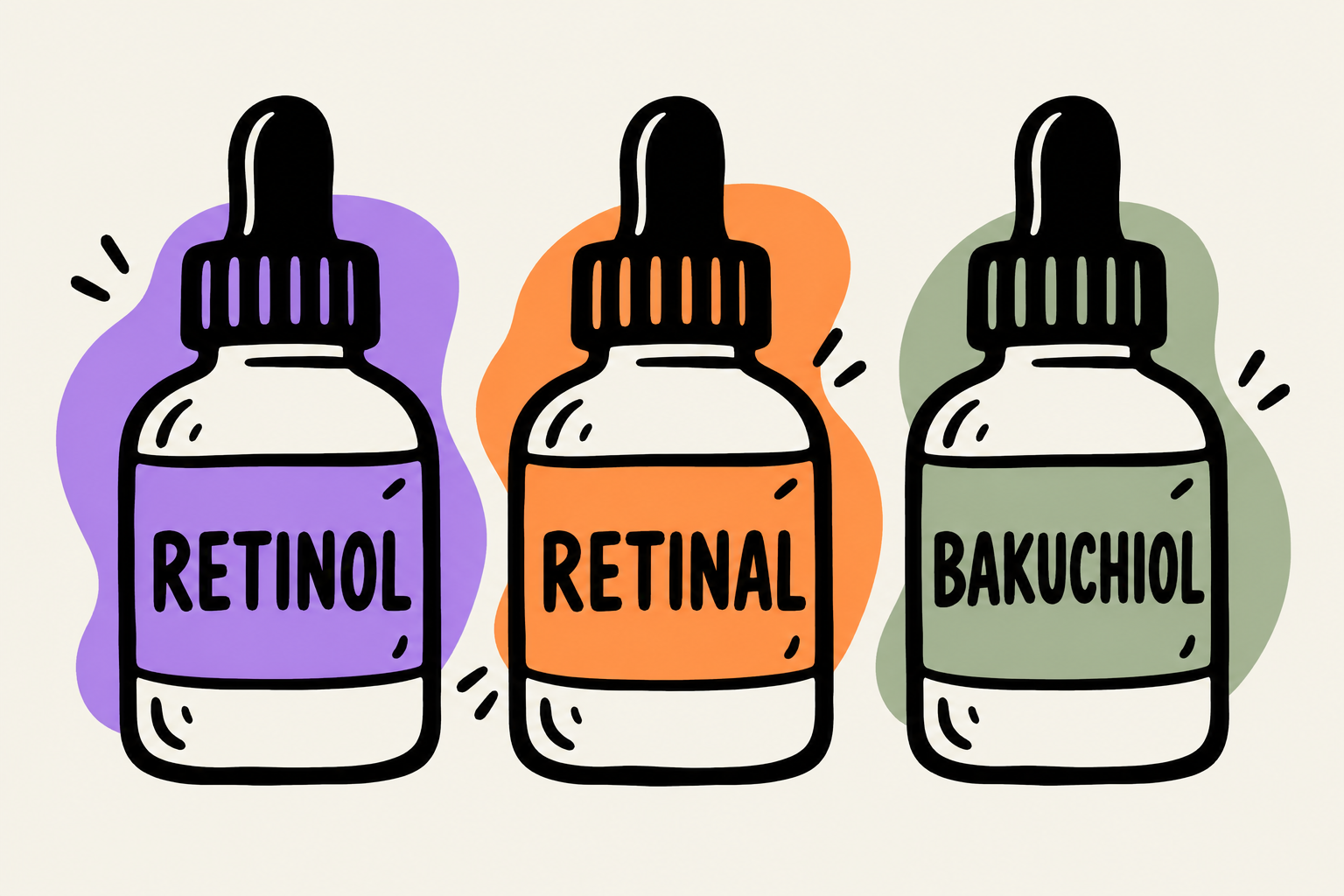
Anti-aging ingredient choice has gotten more complicated in recent years as retinal and bakuchiol have emerged as alternatives to standard retinol, and Korean brands have adopted all three at varying rates. Here’s how they actually compare.
This article is general information, not medical advice. If you’re dealing with persistent acne, rosacea, eczema or another skin condition, please see a dermatologist.
Retinol: The Established Standard
Retinol is a vitamin A derivative that must be converted by skin cells (through a two-step process) into retinoic acid, the biologically active form that actually drives cell turnover and collagen support. This conversion requirement is part of why retinol, while effective, has a somewhat slower onset and is usually introduced gradually, because some people get temporary dryness, flaking or irritation while their skin adjusts. That is irritation, not a required step, and breakouts that persist or a rash are worth raising with a dermatologist. The American Academy of Dermatology suggests starting with the mildest formula, using it every other night at first, applying it at night only and wearing sunscreen during the day (AAD on retinoids and retinol), which matches the gradual, barrier-first approach to introducing actives, covered throughout our routine guides.
Retinal (Retinaldehyde): One Step Closer
Retinal is closer in the conversion pathway to active retinoic acid than retinol, requiring only one conversion step rather than two, which generally translates to faster visible results at comparable irritation levels, or comparable results at a gentler relative strength. Retinal has gained meaningful traction in Korean formulations partly because Korean skincare’s efficiency-and-gentleness-balancing philosophy, discussed throughout this blog, fits well with an ingredient offering a favorable efficacy-to-irritation ratio compared to standard retinol.
Bakuchiol: The Plant-Derived Alternative
Bakuchiol is a plant-derived compound (from the Psoralea corylifolia plant, also called babchi) that isn’t chemically related to vitamin A at all, but has been marketed as a “retinol alternative” based on research suggesting it can produce comparable anti-aging effects through different biochemical pathways, with substantially less irritation potential and no photosensitivity concern.
Comparing Efficacy
Current research suggests a rough hierarchy: retinal > retinol > bakuchiol in terms of raw potency and speed of visible results, though the gap between retinal and well-formulated retinol is narrower than between either and bakuchiol. Bakuchiol’s research base, while promising, remains smaller and less extensive than the decades of accumulated retinol and retinal research, a reasonable but real caveat given how confidently it’s sometimes marketed as directly equivalent. The best-known trial (Dhaliwal et al., British Journal of Dermatology, 2019) randomized 44 adults for 12 weeks and found no significant difference in wrinkle and pigmentation improvement between 0.5% bakuchiol twice daily and 0.5% retinol once daily, with less scaling and stinging in the bakuchiol group. It was small and short, so it supports bakuchiol as a gentler option, not as a proven equal of retinol.
Comparing Irritation and Tolerability
This is where the ranking generally reverses: bakuchiol is best tolerated, followed by retinal, then retinol typically causing the most initial irritation and purging. This makes bakuchiol a reasonable choice for retinoid-intolerant or very sensitive skin, discussed in our sensitive/rosacea-prone routine guide, where standard retinol may simply be too aggressive regardless of gradual introduction.
Sun Sensitivity Differences
Retinol and retinal both increase photosensitivity, requiring diligent sunscreen use (already non-negotiable in Korean routines, as covered throughout this blog) and generally evening-only application. Bakuchiol does not carry the same photosensitivity concern, theoretically allowing daytime use, though most formulations still recommend evening application as a matter of general routine convention rather than a strict biochemical requirement.
Popular Korean Products by Ingredient
- Retinol: various Korean drugstore and mid-range brands offer gentle, gradual-strength retinol serums, often paired with soothing ingredients like Centella asiatica to offset irritation, following the buffer-layer principle
- Retinal: a newer but growing category in Korean formulations, reflecting the broader industry shift toward retinal’s improved efficacy-to-tolerability ratio
- Bakuchiol: increasingly common in Korean “gentle anti-aging” product lines, often marketed specifically toward sensitive skin or those avoiding traditional retinoids
Which Should You Choose?
Choose retinol if: you want the most established, extensively researched option and can tolerate a gradual introduction period.
Choose retinal if: you want a stronger efficacy-to-irritation ratio than standard retinol and don’t mind a somewhat newer, less universally available ingredient.
Choose bakuchiol if: you’re retinoid-intolerant or simply want the gentlest possible anti-aging option. If you are pregnant or breastfeeding, retinoids are generally advised against, but bakuchiol has not been well studied in pregnancy either, so ask your doctor before using either one.
Can You Combine Them?
Generally not recommended to layer multiple vitamin-A-derivative actives (retinol and retinal) simultaneously, since this risks compounding irritation without proportional added benefit. Bakuchiol, given its different mechanism and gentler profile, is sometimes combined with retinol in single formulations specifically to offer complementary anti-aging support with somewhat reduced overall irritation.
Is bakuchiol truly “as effective” as retinol, as some marketing claims?
Existing research suggests meaningful anti-aging benefit, but generally somewhat less potent than retinol at typical formulated concentrations. “Comparable” is a more accurate characterization than “equivalent,” despite how some marketing frames the comparison.
How long does the adjustment period last for retinol or retinal?
Typically 2-4 weeks of gradual introduction (starting a few nights weekly, building up), consistent with the general cautious active-introduction approach covered in our 4-week beginner routine guide.
Can I use any of these with vitamin C or niacinamide?
Generally yes for niacinamide , which pairs well as a buffer; vitamin C is more commonly separated to morning use while retinoids/bakuchiol are used at night, following the AM/PM routine logic covered in our dedicated post.
Retinol, retinal, and bakuchiol occupy a genuine efficacy-versus-tolerability spectrum rather than one being simply “better” than the others. Retinal offers the strongest efficacy-to-irritation balance for most tolerant users, bakuchiol offers the gentlest entry point for sensitive or retinoid-avoidant skin, and standard retinol remains a well-established, extensively researched middle ground.
Korean label tip: retinol and adenosine are on Korea’s MFDS list of ingredients recognised for wrinkle-improvement claims. A Korean product registered as 기능성화장품 for wrinkles has had that claim checked; products built around other actives can only make the same registered claim if the brand has been through a full review. More on what the functional label covers.
Related reading: I Over-Exfoliated With a Glycolic Acid Toner: My Barrier Recovery Diary (Part 1) · Skin Cycling, Korean Style: How It Differs From the Viral Trend
Read Next
Peptides in Korean Skincare: What They Actually Do
Peptides occupy an interesting middle ground in Korean skincare, widely used in anti-aging formulations, frequently…
Mugwort (Ssuk) in Korean Skincare: What the Research Supports and Who Should Skip It
Mugwort is a Korean spring food turned skincare staple. Here’s which Artemisia is on your label, what the studies show, how it compares with centella and heartleaf, and who should be careful.
How to Read a Korean Skincare Ingredient List (And Spot a Fake Hero Ingredient)
A serum named after an ingredient does not have to contain much of it. That…
Propolis in Korean Skincare Explained: Benefits, Products, and How to Use It
Propolis has quietly become one of the more consistently used ingredients across Korean skincare’s brightening…
Niacinamide vs Vitamin C: Which Should You Use First in Your Routine?
Walk into any Olive Young store in Korea and you’ll find entire endcaps dedicated to…
What Does “Hanbang” Mean in Korean Skincare?
“Hanbang” appears constantly in Korean skincare marketing (printed on packaging, used in brand descriptions, referenced…