Double Cleansing Method: Why Koreans Wash Their Face Twice
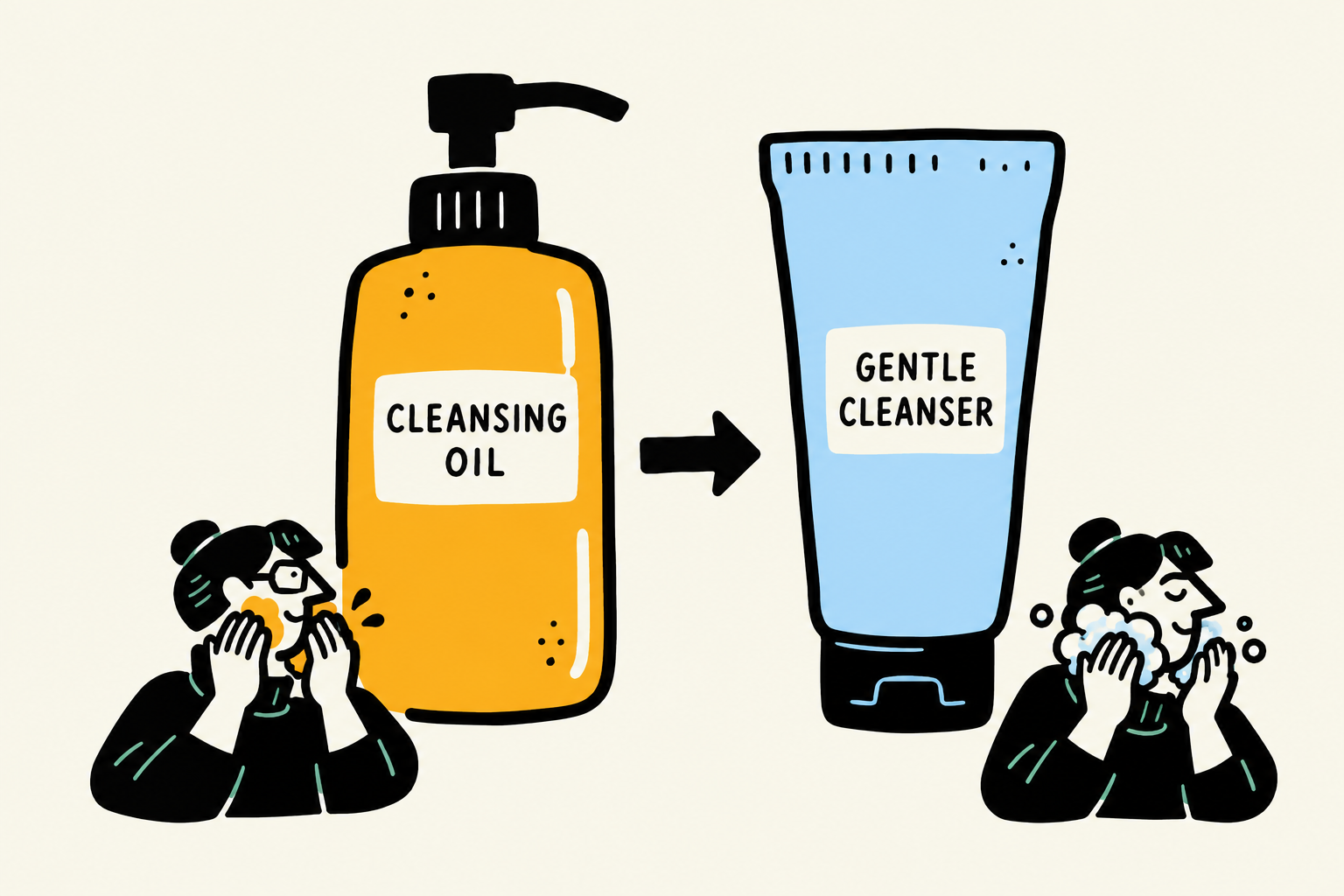
Double cleansing means using a makeup-removal step, often a cleansing oil or balm, followed by a water-based cleanser. It can help with products that are difficult to remove, but washing twice is not essential for everyone and can be uncomfortable if the products or frequency do not suit your skin.
Do You Need One Cleanse or Two?
| Situation | A practical starting point |
|---|---|
| No makeup and products your cleanser removes adequately | A single gentle cleanse may be enough. |
| Long-wear makeup or water-resistant products | Consider a suitable remover first, then assess whether another cleanse is needed. |
| Tightness, stinging or an irritated barrier | Simplify and reassess rather than adding more washing. |
| Morning | Do not double cleanse automatically because you did it the night before. |
These are starting points, not a test of how “Korean” your routine is. Removal depends on the actual makeup or sunscreen, the cleanser and how it is used. There is no rule that every sunscreen needs two cleansers or that one cleanse always leaves skin dirty.
Step 1: Remove Makeup With the Product’s Instructions
A cleansing oil or balm uses an oil-rich formula to loosen makeup and other material, with ingredients that help it rinse away. It is different from rubbing plain kitchen oil onto the face. Some makeup removers are lotions or micellar products instead. For a closer look at the ingredients, see what is actually in a Korean cleansing oil.
For a product that specifies dry application, start with dry skin and hands, gently spread it, then add water if the instructions call for emulsifying. Do not apply a fixed 60 to 90-second massage to every formula. Avoid prolonged rubbing and follow eye-area precautions.
Banila’s official Original instructions describe dry-skin massage, adding water and rinsing. That is the sequence for this example, not proof that every remover has identical directions. The emulsifying guide explains the water-adding step.
Banila Co Clean It Zero Original: A Product Guide
This is a guide based on Banila Co’s published product information, not a first-hand review. It does not assess how well the balm removed my makeup, its after-feel, or whether it caused breakouts.
Which version? This section covers Clean It Zero Original as listed on Banila Co’s US website, checked on October 8, 2026. Original, Calming, Nourishing and Pore Clarifying have separate ingredient lists; check the exact name and the label on the jar you buy.
How to use it: The brand directs users to scoop the balm with the supplied spatula, massage gently onto dry skin, add water and massage again to emulsify, then rinse with lukewarm water. In a double cleanse, this is the first step before your water-based cleanser. For the water-adding step, see our emulsifying guide.
Before buying: The official Original ingredient list includes fragrance, so do not assume it is fragrance-free. The official Calming ingredient list includes eucalyptus, bergamot, rosemary and chamomile oils, while Pore Clarifying lists exfoliating acids. A variant name is not a guarantee that it will suit your skin. Packaging and regional listings may differ; use your jar’s ingredient list to check ingredients you avoid.
Sources: Banila Co Original, Calming, and Pore Clarifying. These are manufacturer sources, not independent comparative tests. For a balm I have used, see my Heimish review.
Step 2: Use a Gentle Water-Based Cleanser if Needed
After rinsing the remover, a water-based cleanser can remove remaining residue. Choose one that you tolerate and follow its directions. More foam does not necessarily mean better removal, and a tight after-feel is not a goal.
The cleanser’s surfactants, fragrance, contact time and frequency matter alongside pH. A “low pH” label does not guarantee a non-irritating formula. Nor is brand reputation a substitute for checking the specific cleanser.
There is no need to add a separate cleanser if a product is designed and used as a sufficient single cleanse for your situation. Keep the decision tied to removal and comfort, not the number of bottles.
What if Double Cleansing Leaves Skin Dry?
Either cleanser, their combination, water temperature, rubbing or washing frequency can contribute to discomfort. It is not accurate to blame only the second cleanser or to declare that the method cannot be drying.
Try simplifying rather than compensating with many extra layers. Do not keep using a product that causes persistent stinging. My barrier recovery diary describes my own experience of simplifying a routine; it does not prove the same response for everyone.
Is an Oil Cleanser Required for Oily or Acne-Prone Skin?
No. Oily skin does not create a requirement to add cleansing oil. The AAD’s oily-skin guidance advises against oil-based cleansers. Some readers may tolerate a formulated remover, but that should not be generalized into a recommendation for every acne-prone person.
A breakout after a new product has several possible explanations. Poor rinsing is not the only one, and a balm is not inherently safer than a liquid oil. Stop and reassess a product that consistently causes problems. See the simplified oily-skin routine for core versus optional steps.
Choosing Between an Oil, Balm and Micellar Remover
An oil is usually fluid; a balm changes texture as it is spread; a micellar remover is used according to its own directions. Texture does not establish cleansing strength, acne compatibility or fragrance status.
Check the exact version and ingredients you avoid. A short list is not automatically gentler, and the word “Calming” is not proof that a variant suits sensitive skin. For a balm discussed through actual use rather than a manufacturer guide, read the Heimish review.
Common Questions
Does oil always dissolve every sunscreen? Removal depends on the sunscreen film and the finished cleanser. Follow the product instructions rather than treating a chemistry slogan as a universal removal test.
Should I double cleanse in the morning? Not automatically. Choose the cleansing needed for your own situation rather than repeating an evening makeup-removal routine.
Does higher pH mean a cleanser is definitely harsh? pH is one factor. It cannot rank complete formulas by itself. Persistent discomfort is a reason to reconsider a cleanser regardless of the label.
Do I need to feel squeaky clean? No. Aim for adequate removal without prolonged rubbing or persistent tightness. If you cannot achieve that comfortably, review the products and seek advice for ongoing skin concerns.
Read Next
Essence vs. Serum: What’s Actually the Difference?
Few Korean skincare terms confuse beginners as consistently as “essence” versus “serum.” Both sit in…
What Does “Cruelty-Free” Mean for Korean Beauty Brands?
“Cruelty-free” labeling is more complicated for Korean cosmetics brands than for many Western brands, due…
Why Sheet Masks Are Everywhere in Korea (And How to Actually Use Them)
Sheet masks are one of the most immediately recognizable K-beauty exports, thin, essence-soaked sheets sold…
Niacinamide or Vitamin C: Which Should You Start With for Uneven Tone?
This is a common question when starting a Korean routine, and it usually comes up…
Physical vs. Chemical Sunscreen: The Korean Perspective
The physical-versus-chemical sunscreen debate plays out differently in Korean skincare culture than in many Western…
Beauty of Joseon vs Anua, a Product Pick Guide
This is a pick guide rather than a verdict on which brand is better. It…