Physical vs. Chemical Sunscreen: The Korean Perspective
The physical-versus-chemical sunscreen debate plays out differently in Korean skincare culture than in many Western markets, largely because of the regulatory and formulation factors covered in our Korean sunscreens guide. Understanding this Korean-specific angle helps explain why Korean sunscreen recommendations sometimes diverge from general international sunscreen advice.
This article is general information, not medical advice. If you’re dealing with persistent acne, rosacea, eczema or another skin condition, please see a dermatologist.
The short answer
The physical-versus-chemical sunscreen debate takes on a distinctly Korean flavor due to the broader chemical filter palette Korean formulators have regulatory access to, and the strong cultural preference for whitecast-free, cosmetically elegant textures. Rather than treating one category as universally superior, the more useful question is which specific formulation your skin tolerates well and which texture you’ll actually reapply consistently. The best sunscreen is ultimately the one you’ll wear every day.
The Basic Distinction
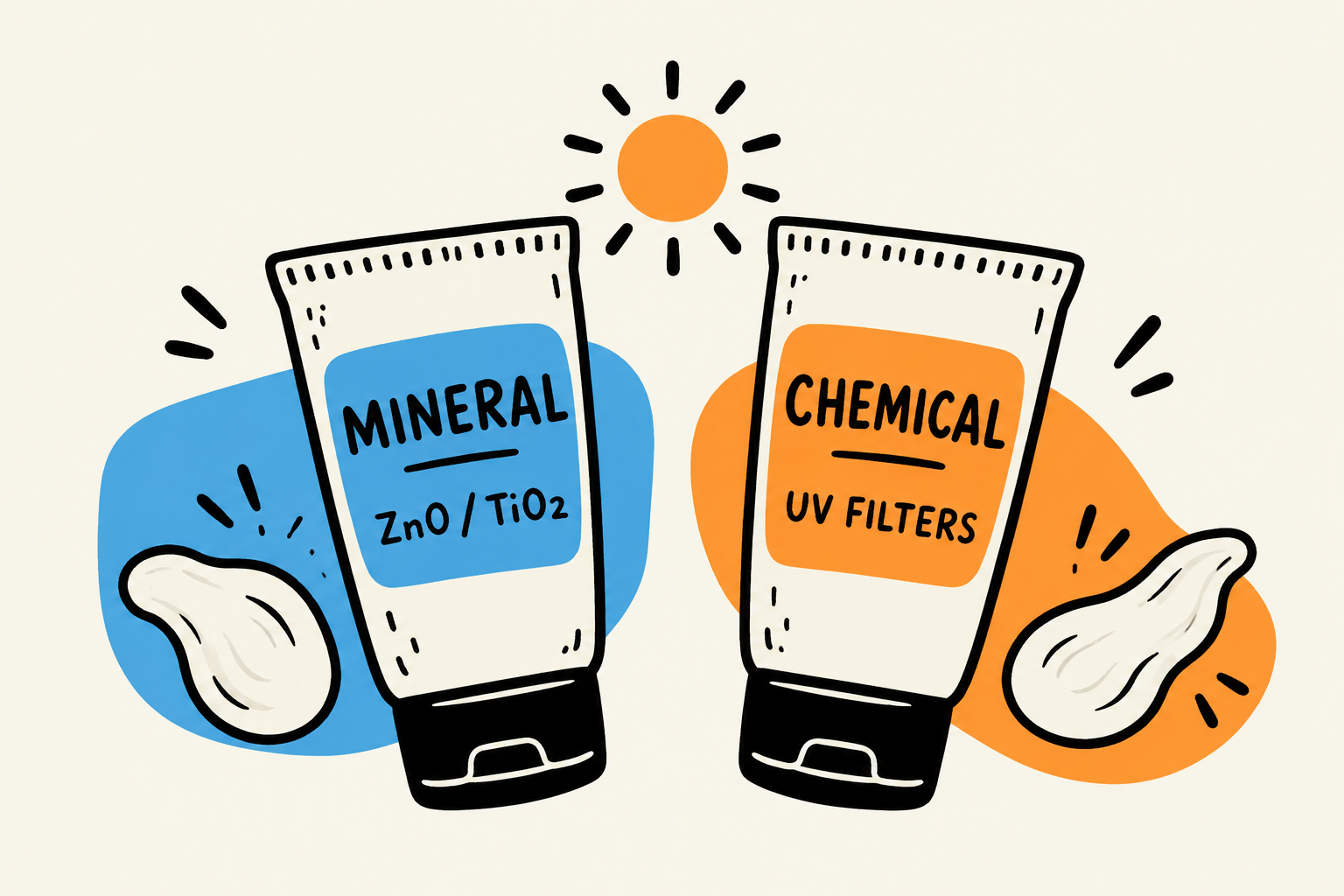
Physical (mineral) sunscreens use zinc oxide and/or titanium dioxide, which stay on the surface of the skin. Contrary to the common explanation that they simply bounce UV away, research shows these mineral filters block UV mainly by absorbing it, with only a small share (roughly 4 to 5%) scattered (summary of Cole et al., 2016). Chemical sunscreens use organic compounds that absorb UV radiation and convert it to heat, which is then released from the skin.
Why This Debate Looks Different in Korea
As discussed in our Korean sunscreen guide, Korea’s regulatory environment (MFDS) approves a considerably broader range of chemical UV filters than the US FDA, including several, like Uvinul A Plus, with strong safety and efficacy track records that remain unapproved in the US. Tinosorb S (bemotrizinol) was the first new filter the FDA approved in decades, in June 2026, so it may start appearing in US products. This means the “physical vs. chemical” conversation in Korean skincare often centers on different chemical filter options than the same conversation in US-focused skincare media.
The Whitecast Problem and Why It Shapes Korean Preferences
Mineral sunscreens’ well-known “whitecast” issue (a grayish or purplish film, particularly visible on medium-to-deep skin tones) is a significant driver of Korean sunscreen formulation trends, discussed at length in our sunscreen guide. Given Korean beauty culture’s strong preference for an even, luminous complexion (the “glass skin” aesthetic covered in a separate post), whitecast is considered a serious cosmetic dealbreaker, pushing Korean sunscreen R&D heavily toward chemical and hybrid formulations that avoid this issue.
This is a meaningful contrast to some Western “clean beauty” trends that have pushed toward mineral-only sunscreens over the past several years, often prioritizing perceived ingredient simplicity over the whitecast trade-off.
Efficacy: Is One Actually Better?
Both physical and chemical sunscreens, when properly formulated and applied at adequate thickness, provide effective broad-spectrum protection. The physical-vs-chemical distinction is not primarily an efficacy question when comparing well-made products in either category. The more meaningful practical differences are:
- Texture and cosmetic elegance. Chemical filters generally allow lighter, less visibly cast textures, which is the main driver of Korean formulation preference
- Sensitivity. Some people experience stinging or irritation from certain chemical filters, making mineral formulations a better personal fit despite the whitecast trade-off
- Photostability. Some older chemical filters degrade in sunlight faster than modern stabilized formulations or mineral filters, though this has improved significantly with modern filter combinations
Hybrid Formulations: The Korean Middle Ground
Many popular Korean sunscreens use hybrid formulations combining both mineral and chemical filters, aiming to balance mineral filters’ stability and gentleness with chemical filters’ improved texture and reduced whitecast. This hybrid approach is common in Korean sunscreen formulation and represents a practical middle ground rather than a strict either-or choice.
Which Should You Choose?
Choose chemical or hybrid Korean sunscreens if:
- Whitecast is a significant concern, particularly on medium-to-deep skin tones
- You prioritize a lightweight, cosmetically elegant daily-wear texture
- You haven’t experienced sensitivity to chemical UV filters in the past
Choose mineral sunscreens if:
- You have a history of sensitivity or stinging with chemical filters
- You have very reactive or rosacea-prone skin, discussed in our sensitive skin routine guide, where mineral formulations are sometimes better tolerated
- Regulatory availability limits your access to some of the more advanced chemical filters common in Korean formulations (relevant primarily for US-based shoppers relying on domestically formulated sunscreens rather than imported Korean products)
The Two Filters Worth Avoiding
Treating “chemical filters” as one category is where most of the confusion comes from. They are a family of very different molecules developed across several decades, and the two oldest are the reason the whole family got its reputation.
Oxybenzone is the stronger case. It is a well-documented contact allergen, it is behind a disproportionate share of the irritation people attribute to chemical sunscreen generally, and it is the filter at the centre of the absorption studies that generated the alarming headlines a few years ago.
Avobenzone is a subtler problem. It is the main UVA filter available in the United States, and on its own it is photounstable. It degrades measurably under the very light it is meant to block, which is why it always appears alongside a stabiliser. It works, but it is a filter that needs propping up.
The argument against them is not that they are dangerous. It is that there is no longer any reason to use them. Korean formulations have access to a generation of filters the US market has largely lacked, such as Uvinul A Plus, Tinosorb M and Uvinul T150 (Tinosorb S was only approved by the FDA in June 2026), which are more photostable, better tolerated, and a large part of why Korean sunscreens feel lighter than their American equivalents. That regulatory gap is the same one discussed above, viewed from the ingredient side.
So the useful check is not “is this chemical or mineral”. It is: turn the bottle over, and if oxybenzone or avobenzone is in the filter list of a Korean product, ask why, because the better options were available to that formulator. Budget lines are where they still turn up most often.
Mineral Is Not Automatically the Safer Choice
The framing above, reactive skin goes mineral, is the standard advice, and it holds often enough to be worth repeating. It is also not a rule, and the exception is common enough that it deserves stating plainly.
Dermatologists who see a lot of acne patients report the opposite pattern frequently: people who break out consistently on mineral sunscreens and do noticeably better on chemical ones. The likely culprit is not zinc or titanium themselves but what has to be put around them. Mineral filters need heavy dispersing agents and occlusive vehicles to spread at all, and those are the parts congested skin objects to.
Which means the honest version of the advice is that neither category is inherently gentler. If sunscreen breaks you out or stings, the useful experiment is to switch categories rather than to switch products within the one you assumed was safer.
A Note on “Chemical Sunscreens Are Absorbed Into the Bloodstream” Concerns
This has been a subject of genuine scientific study and media discussion in recent years, primarily in US regulatory contexts. Current dermatological consensus, including from major professional dermatology organizations, is that established chemical UV filters remain safe for regular topical use at approved concentrations, though research into specific filters’ systemic absorption continues as an area of ongoing scientific interest rather than an established safety concern requiring avoidance.
A Few Quick Answers
Are Korean chemical sunscreens safe even though some filters aren’t FDA-approved?
Generally yes. Non-FDA-approval typically reflects the slower, more conservative nature of the US regulatory review process rather than a specific safety finding against these filters, many of which have strong safety records in Korea, Europe, and other regulatory markets.
Can I mix a Korean chemical sunscreen with a Western mineral sunscreen?
Generally not recommended to layer two full sunscreen products. Pick one as your primary daily sunscreen and reapply that same product rather than combining different formulations, which can affect even coverage and photostability.
Does mineral sunscreen work better for acne-prone skin?
Not inherently. The oily/acne-prone routine guide on this blog notes that well-formulated chemical and hybrid Korean sunscreens, like Beauty of Joseon’s Relief Sun, are frequently recommended specifically for oily and acne-prone skin due to their lightweight, non-comedogenic textures.
Korean label tip: in Korea, a sunscreen can only print SPF and PA ratings if it is registered as a 기능성화장품 (“functional cosmetic”) for UV protection. When you buy a Korean sunscreen, that line on the back label is a quick sign the ratings went through the MFDS process. Here’s how the functional label works.
Read Next
Double Cleansing Method: Why Koreans Wash Their Face Twice
Double cleansing means using a makeup-removal step, often a cleansing oil or balm, followed by…
Beauty of Joseon vs Anua, a Product Pick Guide
This is a pick guide rather than a verdict on which brand is better. It…
Niacinamide or Vitamin C: Which Should You Start With for Uneven Tone?
This is a common question when starting a Korean routine, and it usually comes up…
K-Beauty vs J-Beauty vs C-Beauty: Market Comparison
K-beauty means Korean beauty, J-beauty Japanese beauty and C-beauty Chinese beauty. These labels identify markets…
What “기능성화장품” on a Korean Label Actually Means
Korea’s “functional cosmetic” label means a product’s brightening, anti-wrinkle or UV claim has been checked by the MFDS. Here’s what it covers, how products earn it, and what it doesn’t promise.
Why Sheet Masks Are Everywhere in Korea (And How to Actually Use Them)
Sheet masks are one of the most immediately recognizable K-beauty exports, thin, essence-soaked sheets sold…