Niacinamide vs Vitamin C: Which Should You Use First in Your Routine?
Walk into any Olive Young store in Korea and you’ll find entire endcaps dedicated to two ingredients: niacinamide and vitamin C. Both are staples of Korean brightening (“미백,” mibaek) skincare, and both are marketed aggressively toward the pursuit of the “glass skin” glow. But they work differently, they’re sometimes wrongly said to cancel each other out, and figuring out which one to prioritize, or how to use both, trips up even experienced skincare users. Here’s a clear breakdown.
This article is general information, not medical advice. If you’re dealing with persistent acne, rosacea, eczema or another skin condition, please see a dermatologist.
What Niacinamide Actually Does
Niacinamide (vitamin B3) is one of the most versatile ingredients in skincare, which is exactly why Korean formulators lean on it so heavily. It’s stable, doesn’t require a low pH to work (unlike vitamin C), and layers easily with almost everything else in a routine. Its main benefits include:
- Reducing the appearance of pores by regulating sebum production over time
- Evening out tone and reducing hyperpigmentation, including post-acne marks, a huge concern in Korean skincare culture, where “잡티” (japtti, or dark spots/blemishes) correction is a dedicated product category
- Strengthening the skin barrier by boosting ceramide production
- Calming redness and inflammation
Niacinamide is now common in Korean serums, toners and moisturizers at a wide range of strengths, so it is worth checking the printed percentage and the full ingredient list rather than relying on the product name.
How strong is the evidence? It differs by claim. For pigmentation, a 2022 integrative review of randomized trials concluded that niacinamide lightens melasma related hyperpigmentation (while noting that recent evidence on pure niacinamide is limited), a 2026 narrative review describes one report where 4 percent niacinamide performed comparably to 4 percent hydroquinone, and Bissett et al., 2005 found fewer hyperpigmented spots with 5 percent niacinamide over 12 weeks in a split face study of 50 women. I did not verify the evidence for the pore and ceramide claims in this list, so treat those as less certain.
What Vitamin C Actually Does
Vitamin C (most commonly L-ascorbic acid, though Korean brands frequently use gentler derivatives like ascorbyl glucoside or sodium ascorbyl phosphate) is primarily an antioxidant. Its core benefits:
- Neutralizing free radical damage from UV exposure and pollution, a genuine concern in cities like Seoul, where air quality/fine dust (“미세먼지,” miksemeonji) is a daily topic of conversation and a frequently cited reason Koreans layer antioxidant serums each morning
- Brightening skin tone and fading dark spots by inhibiting melanin production
- Supporting collagen synthesis, giving it a mild anti-aging benefit
Unlike niacinamide, pure L-ascorbic acid is notoriously unstable. It oxidizes when exposed to light and air, turning a serum brownish and less effective. This is why Korean vitamin C serums so often come in small, dark, air-tight packaging, and why brands like Klairs (with its famous Freshly Juiced Vitamin Drop) built a cult following specifically around solving vitamin C’s stability problem.
Do They Actually Cancel Each Other Out?
This is the most persistent myth in the niacinamide-vs-vitamin-C conversation, and it is often traced to old research done under very specific lab conditions (high heat, unstable formulations), a history I could not verify. I did not find a primary study showing a problem with modern formulations. In practice, many people use them together:
- Modern, stabilized formulations of both ingredients are commonly used together, though I did not find trial evidence that settles whether efficacy is affected.
- Some people do report temporary flushing or tingling when combining high concentrations of both, which is a tolerance issue rather than a chemical cancellation issue.
- If your skin is sensitive, the more cautious approach is to separate them by time of day rather than avoid combining them entirely.
The Practical Answer: Split by Time of Day
Korean routines actually solved this debate structurally, long before it became a Western skincare forum argument. The general convention:
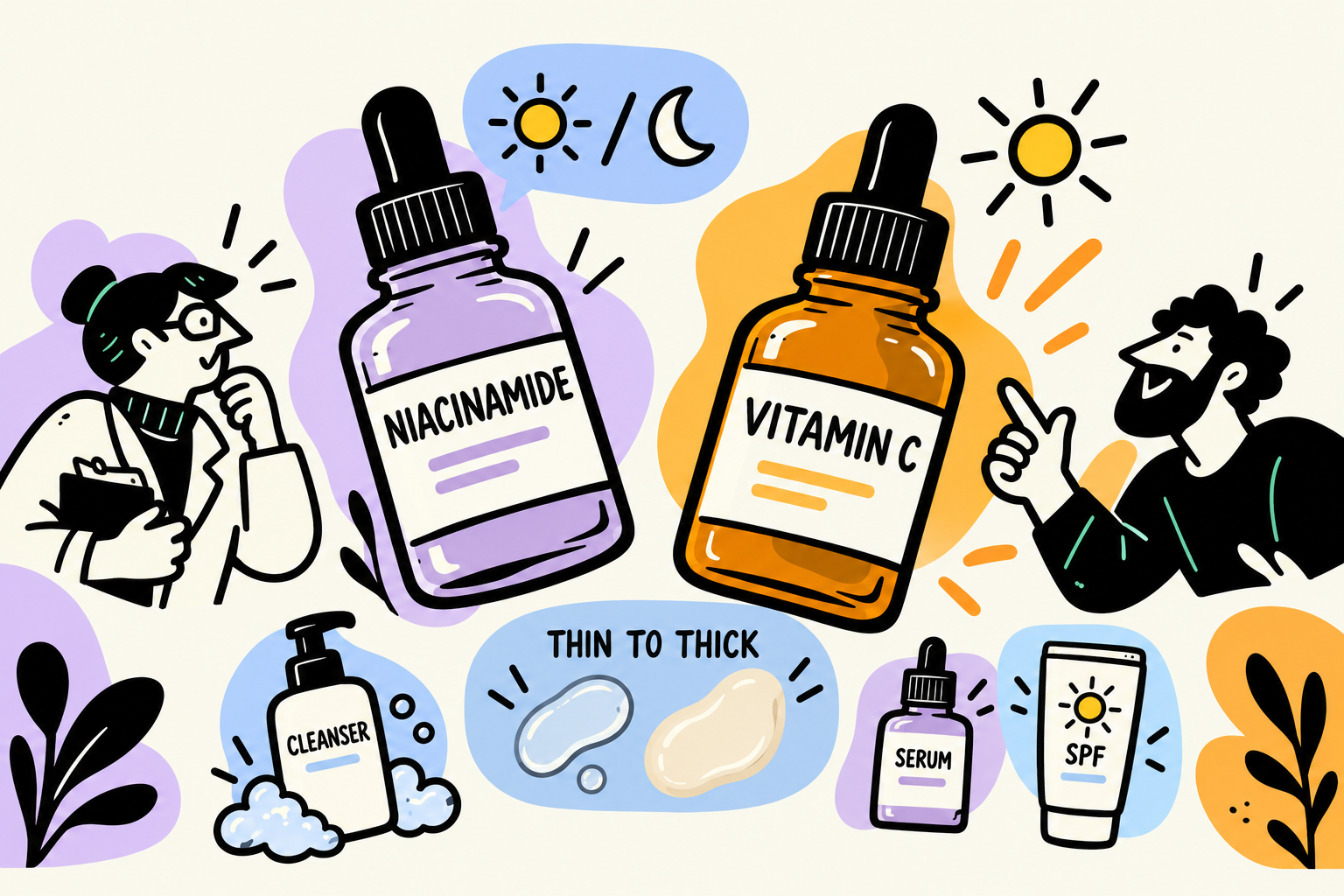
- Vitamin C in the morning. Since its antioxidant function is specifically useful for neutralizing daytime environmental damage (UV, pollution, blue light), and it pairs well underneath sunscreen for added protection.
- Niacinamide in the morning, evening, or both. Because it’s stable, non-irritating, and functions well regardless of time of day. Many Korean toners and essences include niacinamide as a base ingredient specifically so it can be used as often as needed without a specific “slot.”
If you want to use both in the same routine at the same time, apply the thinner, more water-like product first (usually vitamin C serum) and let it absorb for a minute or two before layering niacinamide on top.
Which One Should You Prioritize First?
If you can only add one ingredient right now:
- Choose niacinamide first if your main concerns are pore appearance, general skin barrier weakness, mild redness, or you’re new to actives and want something forgiving and stable.
- Choose vitamin C first if your main concern is stubborn hyperpigmentation, sun damage, or dullness, and you’re diligent about storage (keeping it away from light/heat) and willing to replace it every few months as it naturally degrades.
Many Korean skincare routines eventually incorporate both, but niacinamide is generally considered the safer, more universal starting point, which is part of why it shows up as a base ingredient in so many Korean toners, essences, and even sunscreens, rather than only in dedicated serums.
Popular Korean Products for Each
Niacinamide:
- Some By Mi Galactomyces Pure Vitamin C Glow Serum (despite the name, it’s niacinamide-forward)
Vitamin C:
- Klairs Freshly Juiced Vitamin Drop
- Neogen Real Vita C Serum
Can I use both in the same 10-step routine?
Yes. The 10-step routine’s entire premise is layering thin-to-thick products, so slotting vitamin C as an early serum and niacinamide as a following essence or serum step works naturally within that structure.
Will niacinamide or vitamin C replace sunscreen?
No. Both support skin health and can reduce the visible impact of sun damage over time, but neither provides SPF protection. Korean routines always treat sunscreen as a completely separate, non-negotiable final step.
How long until I see results?
Niacinamide’s pore and tone benefits typically show gradual improvement over 8-12 weeks of consistent use. Vitamin C’s brightening effects can appear slightly faster, often within 4-6 weeks, though this varies significantly by formulation and concentration.
Is it true Korean brands use lower vitamin C concentrations than Western brands?
Often, yes. Korean formulations frequently favor gentler derivatives (like ascorbyl glucoside) over the harsher 15-20% L-ascorbic acid concentrations common in some Western prestige brands, reflecting a broader Korean skincare philosophy that favors gradual, barrier-friendly results over aggressive, fast-acting formulas.
Niacinamide and vitamin C aren’t rivals. They’re complementary tools solving different problems, and the “they cancel each other out” myth is largely outdated. If you’re building a routine from scratch, start with niacinamide for its versatility and gentleness, then layer in vitamin C once your skin has adjusted, ideally reserved for morning use where its antioxidant properties do the most work.
Related reading, Niacinamide or Vitamin C: Which Should You Start With for Uneven Tone?
Korean label tip: niacinamide is one of the ingredients Korea’s Ministry of Food and Drug Safety (MFDS) recognises for brightening claims, at 2–5%. If a Korean niacinamide product has 기능성화장품 (“functional cosmetic”) on the back label with a brightening claim, that claim has been checked. Here’s how to read that label.
Sources: For vitamin C and pigmentation, a 2023 systematic review in the Journal of Cosmetic Dermatology (seven studies, 139 volunteers) reported measurable lightening in melasma and pigmentation and smoother skin in photoaging, with the authors noting that the ideal concentration is not established and more studies are needed. For niacinamide: Pedroso et al., 2022 (Research, Society and Development), Ciszewska et al., 2026 (Quality in Sport) and Bissett et al., 2005 (Dermatologic Surgery). These studies look at each ingredient separately and do not compare the two directly.
Read Next
Ceramides Explained: The Ingredient Behind Every Barrier Cream
Ceramides don’t generate viral hype the way snail mucin or Centella asiatica do, but they’re…
PHA vs AHA vs BHA: A Beginner’s Guide to Chemical Exfoliants
AHA, BHA and PHA are families of exfoliating ingredients. The useful comparison is the concern…
What Does “Emulsify” Mean in Skincare? A Cleansing Oil Explainer
In cleansing-oil instructions, “emulsify” means adding water and gently working it through the cleanser so…
What’s Actually in a Korean Cleansing Oil? Ingredients Explained
Cleansing oils look deceptively simple on the ingredient label, often just a handful of oil…
Mugwort (Ssuk) in Korean Skincare: What the Research Supports and Who Should Skip It
Mugwort is a Korean spring food turned skincare staple. Here’s which Artemisia is on your label, what the studies show, how it compares with centella and heartleaf, and who should be careful.
The Azelaic Acid pH Controversy: What It Actually Proves (And What It Does Not)
This is the second post in a series about reading what is actually in a…