Niacinamide or Vitamin C: Which Should You Start With for Uneven Tone?
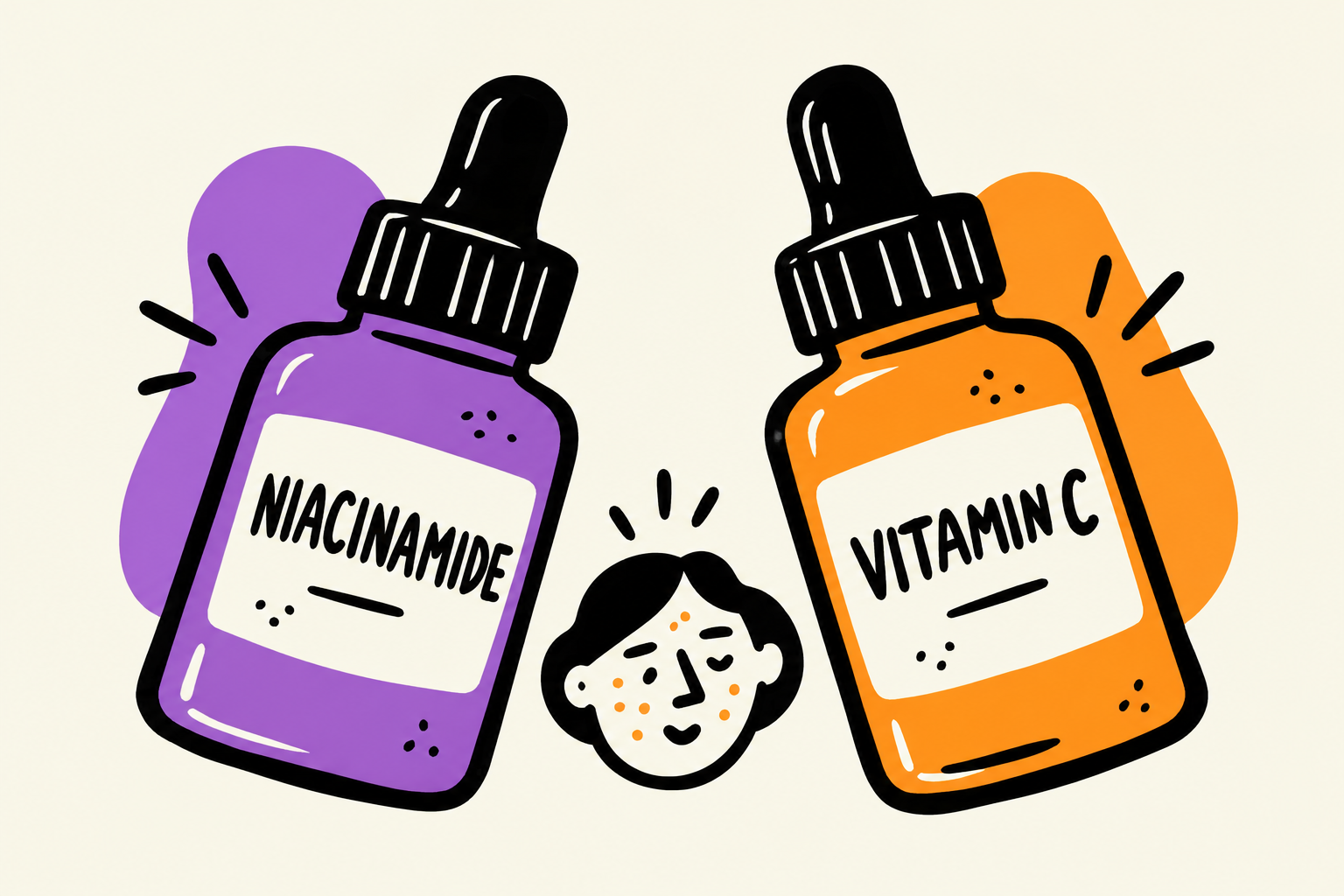
This is a common question when starting a Korean routine, and it usually comes up like this: there is a budget Korean niacinamide serum and a budget Korean vitamin C serum, both cost about the same, uneven tone is the concern, and which one should actually go in the basket first.
It is a better question than it looks, because the honest answer depends on something people rarely ask themselves before buying either.
The Short Answer
A reasonable default is to start with niacinamide. It is generally better tolerated, it is more stable in the bottle, and it is easy to layer. Vitamin C is the harder product to own well, and at a budget price point it is easier to buy a bad one. I did not find a head to head trial of the two, so this post is about practicality, not about which ingredient is stronger.
Each has some evidence for pigmentation when studied separately. A 2023 systematic review of topical vitamin C (seven studies, 139 volunteers) reported measurable lightening in melasma and pigmentation, but the authors say the ideal concentration is not established and more studies are needed. For niacinamide, a 2022 integrative review of randomized trials concluded that it lightens melasma related hyperpigmentation while noting that little recent evidence uses pure niacinamide, and a 2026 narrative review describes one report where 4 percent niacinamide performed comparably to 4 percent hydroquinone with better tolerability, although many of the studies it covers combine niacinamide with other treatments. These are different conditions, products and study designs, so they cannot tell you which one wins for your face.
The exception is if your uneven tone is specifically dark marks left behind by old spots rather than general dullness or redness. In that case vitamin C may be worth the extra care, although I did not find a trial showing it works better than niacinamide for that problem.
What Each One Does to Uneven Tone
“Uneven tone” covers at least three different problems. The table below is my practical summary of how people usually choose, not a comparison from a trial.
| What you are actually seeing | Niacinamide | Vitamin C |
|---|---|---|
| Dark marks left by past breakouts | Helps, slowly | Better suited |
| General dullness, grey or tired-looking skin | Helps | Better suited |
| Redness and blotchiness | Better suited | Can make it worse |
| Visible pores and oiliness alongside the tone issue | Better suited | Not its main use |
| Sun-related pigmentation | Helps | Helps, and protects |
If two or more of those rows describe your face, niacinamide is the more general-purpose first buy, though a minority of people flush or prickle on it.
Why Niacinamide Is the Easier First Buy
Three practical reasons, none of them about which ingredient is stronger.
It is generally stable. Niacinamide is generally stable in the bottle, though any serum lasts longer away from heat and sunlight. A pure vitamin C serum can oxidise once opened, and a cheap one in clear packaging may be spent before you have formed an opinion of it.
It is easy to layer. You can usually put it under sunscreen, over a toner, or beside many other actives, morning or night. Pure vitamin C products often want clean dry skin, a particular order, and ideally a slot of its own.
Cheap versions are usually fine. Niacinamide is an inexpensive, stable raw material, so a budget Korean formula at a real concentration is genuinely competitive with an expensive one. That is not true of vitamin C, where the packaging, the solvent system and the freshness of the stock all cost money, and skimping on any of them shows.
The one thing to check is the strength. Human studies have used roughly 2 to 5 percent niacinamide (Hakozaki et al., 2002, Bissett et al., 2005), which makes it a reasonable label check rather than a proven optimum. Korean labels often print parts per million instead. If a product lists 20,000 ppm of niacinamide, that is 2 percent, and 5,000 ppm is half a percent, below the range in those studies. Check whether the ppm figure refers to pure niacinamide or to a raw material mixture. I went through that arithmetic and the rest of the label-reading in the guide to reading a Korean ingredient list.
When Vitamin C Should Be First Instead
Pick vitamin C first if dark marks are the whole problem, your skin is not reactive, and you will realistically finish a bottle within about three months.
If you go that way, one decision matters more than the price: which form you are buying. Pure L-ascorbic acid is the potent, fragile one; the derivatives are gentler, stable, and less certain. They are not interchangeable and the percentages on the front are not comparable between them, which I worked through in the post on pure vitamin C versus its derivatives. For a first budget purchase, a derivative is the lower-risk option even though it is the weaker one.
Already own both and wondering how to layer them or when to use each? Our niacinamide vs vitamin C guide covers timing and layering. This post is about which one to buy first when uneven tone is the goal.
Can You Just Use Both?
Many people use them together. I did not find a primary study showing a problem with modern serums, but I also did not find trial evidence that settles the question, so go slowly and watch how your skin responds.
But buying both at once is a bad idea for a different reason: you will not know which one did anything. If the tone improves you will keep buying both forever, and if your skin objects you will not know which bottle to blame. Run one for eight to twelve weeks, decide, then add the second if you still want to.
When you do run both, the easiest arrangement is vitamin C in the morning on clean skin and niacinamide at whichever end of the day is less crowded.
What Neither of Them Will Do
Both ingredients work on pigment that already exists. Neither stops your skin making more of it, and sun exposure makes more of it every single day. A serum without daily sunscreen is a bucket with a hole in it, and this is the single most common reason people conclude that either ingredient “did nothing”.
Timelines are also slower than the marketing implies. In the niacinamide studies I found, changes were measured after 4 weeks (Hakozaki et al., 2002) and 12 weeks (Bissett et al., 2005), so judge over at least that long by comparing photos taken in the same light. Results vary, and stubborn pigmentation may take longer or need a dermatologist’s advice.
And if your uneven tone is textured rather than just discoloured (raised, rough, or scarred), neither of these is the right tool. Texture changes like these usually need a different approach, and a dermatologist can tell you whether a retinoid is appropriate.
Quick Questions
Is a budget Korean niacinamide serum as good as an expensive one?
I did not find studies comparing budget and expensive niacinamide serums. The concentration and formulation matter, so check the label, and price may mostly reflect texture and packaging.
What if niacinamide stings?
Some people flush or prickle on it. Try a lower strength, and if it still stings after a fair trial, stop using it. That is a reasonable point to switch to a gentle vitamin C derivative instead.
How do I know if my vitamin C has gone off?
Colour. Clear or pale straw is fine; yellow is on the way out; orange or brown is finished. A browned serum is not stronger, it is spent.
Should I use them every day?
Niacinamide, yes, daily. Vitamin C, daily if your skin is comfortable with it, and every other day if it stings at first. Consistency does more here than intensity.
Wrapping Up
For a first serum aimed at uneven tone, on a budget, from a Korean brand: niacinamide at a strength in the range used in studies (about two to five percent), used every day, under sunscreen. It is the lower-risk purchase and the easier product to live with.
Keep vitamin C as the second step rather than the first, and buy it more carefully when you do: small bottle, opaque packaging, and a plan to finish it. The order matters more than the choice, and starting with the forgiving one is what gets people to month three, which is where either of them actually starts to show.
Sources: Hakozaki et al., 2002, “The effect of niacinamide on reducing cutaneous pigmentation and suppression of melanosome transfer,” British Journal of Dermatology (4 weeks, 5% in 18 adults with hyperpigmentation and 2% with sunscreen in a separate group). Bissett et al., 2005, “Niacinamide: A B vitamin that improves aging facial skin appearance,” Dermatologic Surgery (5% for 12 weeks, 50 women, split face). Neither study compares niacinamide with vitamin C. For vitamin C absorption and derivatives, see our post on pure vitamin C versus derivatives. Also: Correia et al., 2023, Journal of Cosmetic Dermatology (systematic review of topical vitamin C in melasma and photoaging); Pedroso et al., 2022, Research, Society and Development (integrative review of niacinamide RCTs in melasma); Ciszewska et al., 2026, Quality in Sport (narrative review of topical niacinamide).
Read Next
Physical vs. Chemical Sunscreen: The Korean Perspective
The physical-versus-chemical sunscreen debate plays out differently in Korean skincare culture than in many Western…
What “기능성화장품” on a Korean Label Actually Means
Korea’s “functional cosmetic” label means a product’s brightening, anti-wrinkle or UV claim has been checked by the MFDS. Here’s what it covers, how products earn it, and what it doesn’t promise.
K-Beauty vs J-Beauty vs C-Beauty: Market Comparison
K-beauty means Korean beauty, J-beauty Japanese beauty and C-beauty Chinese beauty. These labels identify markets…
Olive Young Shopping Guide for First-Time Visitors
Olive Young is Korea’s dominant beauty and health retail chain, and for anyone visiting Korea…
What Does “Cruelty-Free” Mean for Korean Beauty Brands?
“Cruelty-free” labeling is more complicated for Korean cosmetics brands than for many Western brands, due…
Essence vs. Serum: What’s Actually the Difference?
Few Korean skincare terms confuse beginners as consistently as “essence” versus “serum.” Both sit in…