Pure Vitamin C vs. Derivatives: Which One Is in Your Brightening Serum?
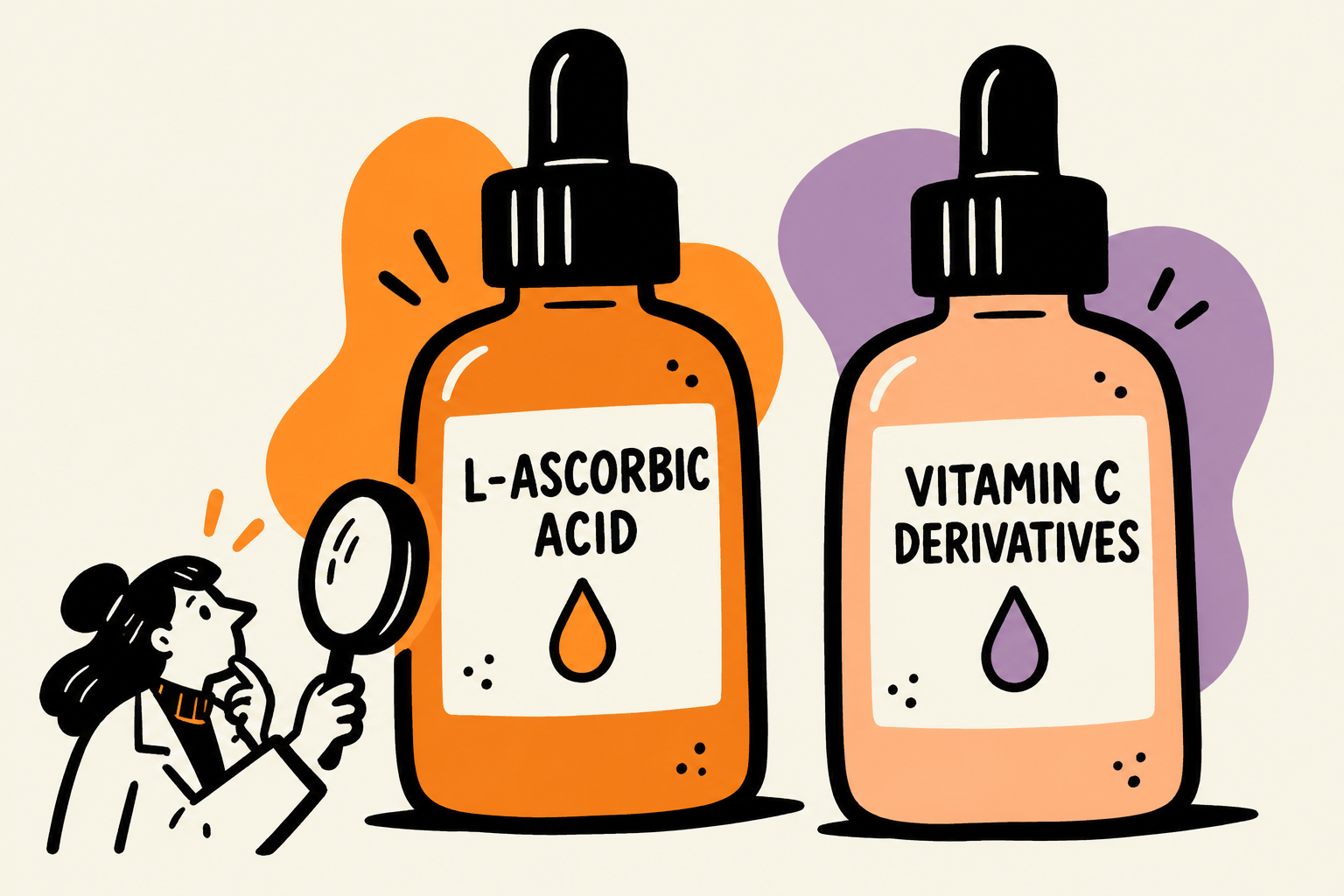
Two serums both say vitamin C on the front. One stings slightly, comes in an opaque bottle, and turns amber after a couple of months. The other feels like nothing, comes in clear glass, and looks identical on the last day as on the first. They are not the same ingredient, and the difference explains most of the confusion about whether vitamin C works.
What “Pure Vitamin C” Actually Means
Pure vitamin C means L-ascorbic acid, the molecule your skin can use directly with no conversion step. A 2023 systematic review of topical vitamin C (seven studies, 139 volunteers) reported measurable lightening in melasma and pigmentation and smoother skin in photoaging, while the authors note that the ideal concentration is not established and more studies are needed. It is also the least convenient molecule in common skincare use.
Its problems are all practical. It needs a low pH to penetrate, which is what causes the tingle. It oxidises on contact with air, light and heat, turning yellow and then brown as it degrades. And once it has oxidised it is not merely weaker, it is done. A browned serum is not a stronger serum, whatever the internet says.
Why Derivatives Exist
A derivative is L-ascorbic acid with something attached to it to make it stable. The attachment survives the bottle, and enzymes in your skin are supposed to cleave it off so the ascorbic acid can get to work.
That “supposed to” is where the whole argument lives. The conversion is real but it is not complete, it varies between derivatives, and for several of them the evidence is thinner than the marketing implies. What you gain is a product that is stable, comfortable, works at skin-friendly pH, and does not need to be used up in three months. What you trade is certainty about how much active is actually arriving.
The Names You Will Actually See
These are the forms that turn up on Korean labels, in rough order of how often I encounter them.
| On the label | Type | What to expect |
|---|---|---|
| Ascorbic acid / L-ascorbic acid | Pure | Strongest evidence, low pH, tingles, oxidises; typically 10 to 20% |
| 3-O-ethyl ascorbic acid | Derivative | Popular in Korea and water-soluble; the sources I read give limited data on how well skin converts it and how it performs in people |
| Sodium ascorbyl phosphate (SAP) | Derivative | Gentle and stable at neutral pH, with limited activity until converted |
| Magnesium ascorbyl phosphate (MAP) | Derivative | Gentle and stable; in the pig skin study cited above it did not increase skin L-ascorbic acid levels under that study’s conditions |
| Ascorbyl glucoside | Derivative | Extremely stable, slow-acting, common in low-cost formulas |
| Tetrahexyldecyl ascorbate (THD) | Oil-soluble derivative | Comfortable, penetrates well, expensive; often in richer textures |
Note that percentages are not comparable across rows. A 15% pure ascorbic acid serum and a 15% ascorbyl glucoside serum are not delivering comparable amounts of usable vitamin C, and no label will tell you the conversion rate. This is the same trap as plant water versus isolated compound, and I went through how to spot that class of problem in the post on reading an ingredient list.
How to Tell Which One You Own
The ingredient list settles it, but there are physical tells that are faster.
- Packaging. Opaque, airless, or dark glass with a small opening usually means pure. Clear bottles and wide jars mean the brand is not worried about oxidation, which means it is not pure.
- Sensation. A brief tingle on application points to low pH and pure ascorbic acid. Derivatives are generally sensation-free.
- Colour over time. If it yellows and then browns, it was pure and it is now spent. A derivative serum that looks the same in month six is behaving correctly.
- Position in your routine. Pure formulas usually instruct application to clean, dry skin before anything else. Derivatives rarely care.
Which One Should You Buy
My honest view after cycling through both camps is that the question is less about potency and more about whether you will finish the bottle correctly.
Go pure if pigmentation is your main concern, your skin is not reactive, and you will realistically use the bottle within about three months. Buy small sizes, keep it away from the bathroom windowsill, and accept that you are on a clock.
Go derivative if your skin stings easily, if you want vitamin C as general antioxidant support rather than as a targeted pigment treatment, or if you are the kind of person who rotates between five serums and will not finish anything in a season. 3-O-ethyl ascorbic acid and THD are the two I would look at first.
What I would not do is buy a pure formula, use it twice a week, leave it on a sunny shelf, and then conclude that vitamin C does nothing. That was my first attempt, and the serum was brown before I had formed any opinion worth having.
Storage, and How Long Results Take
Pure formulas degrade from the moment the seal breaks, and the three accelerants are light, heat and air. A bathroom shelf next to a window is the worst place in the house for one, and a hot shower twice a day does not help. Somewhere dark and cool, with the cap on properly, buys you months.
Derivatives are far more forgiving, which is genuinely part of their value. If your bathroom is warm and bright and you are not going to change that, a stable derivative used consistently will beat a pure formula that spends its life oxidising.
On timelines: results vary, and pigment changes are slow, so compare photos taken in the same light over months rather than judging by a few days. Daily sunscreen matters because UV exposure can keep marks darkening.
Quick Questions
Can I use vitamin C with niacinamide?
Many people use them together, and I did not find a primary study showing a problem with modern serums, but I also did not find trial evidence that settles the question. The idea that they cancel each other out is widely repeated. If your skin reacts, use them at different times of day. The real friction is textural rather than chemical, which I touched on in the piece on the niacinamide and zinc morning routine.
Morning or night?
Morning is the traditional advice because of the antioxidant benefit under daylight, and it is a reasonable default. Night also works. What matters far more is that you wear sunscreen, since vitamin C is supporting protection rather than replacing it.
Is a browned serum dangerous to use?
Not dangerous, just inactive, and occasionally a little sticky. There is no benefit to finishing it, and no harm beyond wasted steps.
What percentage should I look for in a pure formula?
Commercial pure vitamin C serums commonly list somewhere between about 10 and 20 percent, but I did not find a human study that identifies the best percentage. The best known absorption work is a pig skin study (Pinnell et al., 2001), where skin levels peaked at around 20 percent and the acid only entered the skin when the formula was below pH 3.5. That tells you formulation matters, not which number to buy. A 2025 review of topical vitamin C and its derivatives adds that the acidic pH that helps penetration can irritate sensitive skin. Treat the percentage on the front as one clue, and check the pH, packaging and how your skin responds.
Wrapping Up
Pure vitamin C is the better-evidenced ingredient and the harder product to own. Derivatives are the easier product and the less certain ingredient. Neither of those is a flaw exactly; they are two different trades, and the right one depends on your skin and your habits rather than on which is objectively superior.
If you take one thing from this, let it be that the word on the front does not tell you which trade you made. The ingredient list does, and it takes five seconds to check.
Sources: Pinnell et al., 2001, “Topical L-ascorbic acid: percutaneous absorption studies,” Dermatologic Surgery (pig skin study). Esfandiyari and Ahmadi Ashtiani, 2025, Journal of Skin and Stem Cell, Topical Vitamin C and Its Derivatives in Cosmetic Science. Correia et al., 2023, “Efficacy of topical vitamin C in melasma and photoaging: a systematic review,” Journal of Cosmetic Dermatology.
Read Next
What’s Actually in a Korean Cleansing Oil? Ingredients Explained
Cleansing oils look deceptively simple on the ingredient label, often just a handful of oil…
What Does “Emulsify” Mean in Skincare? A Cleansing Oil Explainer
In cleansing-oil instructions, “emulsify” means adding water and gently working it through the cleanser so…
Adenosine: Korea’s Officially Approved Anti-Wrinkle Ingredient
Adenosine occupies a unique regulatory position in Korean skincare that most international shoppers never realize:…
Niacinamide vs Vitamin C: Which Should You Use First in Your Routine?
Walk into any Olive Young store in Korea and you’ll find entire endcaps dedicated to…
Ceramides Explained: The Ingredient Behind Every Barrier Cream
Ceramides don’t generate viral hype the way snail mucin or Centella asiatica do, but they’re…
Retinol vs. Retinal vs. Bakuchiol: Korean Anti-Aging Actives Compared
Anti-aging ingredient choice has gotten more complicated in recent years as retinal and bakuchiol have…