What “기능성화장품” on a Korean Label Actually Means
Flip a skincare product bought in Korea and you will often find a small line of Korean text on the back: 기능성화장품 (gineungseong hwajangpum), or “functional cosmetic.” Most English-language listings drop it or never translate it. That is a shame, because it is one of the more useful pieces of information on a Korean label. It tells you the product has cleared a specific check by Korea’s Ministry of Food and Drug Safety (MFDS) for one particular claim.
This article is general information, not medical advice. If you’re dealing with persistent acne, rosacea, eczema or another skin condition, please see a dermatologist.
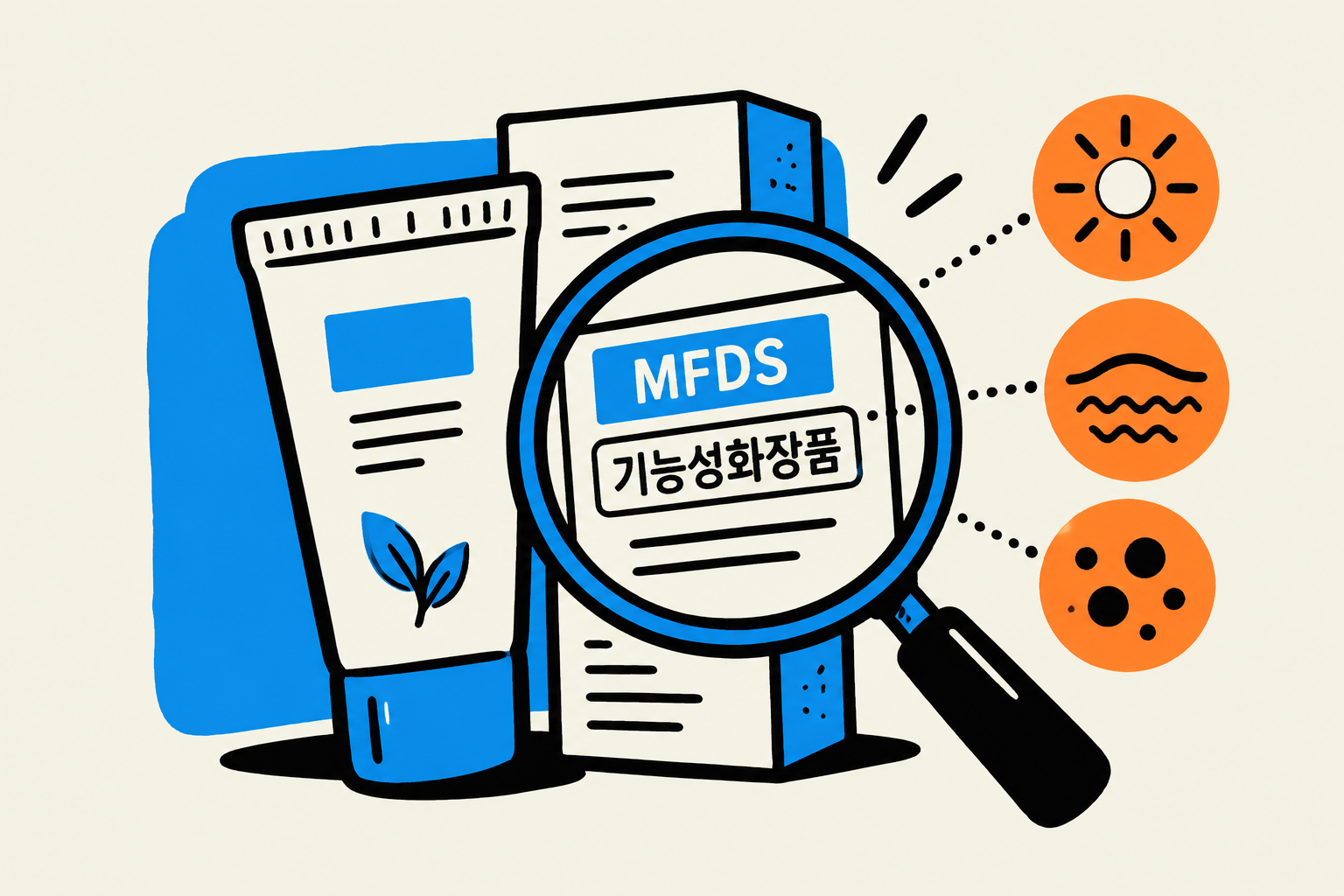
This guide explains what that label covers, how a product earns it, and, just as importantly, what it does not promise.
The Short Version
- In Korea, a product can only make certain claims, such as brightening, wrinkle improvement or UV protection, if it is registered as a functional cosmetic.
- To get there, a brand either uses an active ingredient the MFDS has already vetted, at a set concentration, or submits its own safety and efficacy data for review.
- The label confirms one specific claim. It says nothing about texture, fragrance, or whether the product suits sensitive skin.
The 11 Categories, in Plain English
Korea currently recognises eleven functional categories. Several of them were moved over from the “quasi-drug” category in May 2017, which is why hair-loss shampoos and acne body washes can now carry the same label as a serum.
| Category | What it means on the shelf |
|---|---|
| Whitening (preventing melanin build-up) | Brightening products aimed at stopping new dark spots |
| Whitening (lightening existing pigment) | Products aimed at fading spots you already have |
| Wrinkle and elasticity improvement | The “anti-wrinkle” claim, e.g. adenosine or retinol products |
| Tanning protection | Products that help skin tan evenly without burning |
| UV blocking or scattering | Sunscreens, which carry SPF and PA ratings |
| Hair colour change | Hair dyes and bleaches |
| Hair removal | Depilatory creams |
| Relief of hair-loss symptoms | Hair-loss shampoos and tonics |
| Relief of acne-prone skin | Rinse-off products only, such as cleansers |
| Restoring skin barrier function | Products for dryness and itch linked to a weak barrier |
| Reducing the appearance of stretch marks | Body creams for stretch marks |
A note on the word “whitening”: it is a literal translation of mibaek (미백), and in practice it refers to evening out dark spots and dullness, not changing someone’s natural skin tone. Many brands now use “brightening” in their English copy for exactly that reason.
How a Product Earns the Label
There are two routes, and knowing which one a product took explains a lot about what is inside it.
Route 1: the pre-approved ingredient list
The MFDS keeps a list of active ingredients whose safety and effect it has already accepted, each with a permitted concentration range. If a brand uses one of these within range, it can file a simpler report instead of proving the ingredient works from scratch. This is the route most everyday products take.
A few well-known examples from that list:
- Adenosine at 0.04% for wrinkle improvement. It is the reason so many Korean creams list adenosine far down the ingredient list, a topic covered in our adenosine post.
- Niacinamide at 2–5% and arbutin at 2–5% for brightening.
- Retinol for wrinkle improvement, measured in international units per gram rather than a percentage.
That concentration detail matters. A product that proudly lists niacinamide but is not registered as functional may simply contain less than the amount the MFDS recognises for a brightening claim.
Route 2: a full review
If a brand wants to use a new active ingredient, or go outside the approved ranges, it has to submit a full dossier: safety, stability and efficacy data, often including clinical testing. This is slower and more expensive, which is why brands that take this route tend to mention it prominently.
What the Label Does Not Tell You
- It is not a gentleness rating. A functional brightening serum can still contain fragrance or a high dose of acids. Check the full ingredient list if your skin reacts easily; our sensitive-skin routine covers what to look for.
- It only covers the registered claim. A moisturiser registered for wrinkle improvement has been checked for that claim, not for hydration or pore care.
- It is not a medical approval. Products in the hair-loss, acne, barrier and stretch-mark categories must carry a line stating they are not medicines for preventing or treating disease.
- It is a Korean standard. Export versions sometimes drop the Korean text, and other countries regulate the same claims differently.
How to Check a Product Yourself
- Look for 기능성화장품 on the Korean back label, usually near the product name, along with a short line describing the registered effect (효능·효과).
- On Korean retailer listings, the product details section typically states whether an item is functional and for which category.
- For sunscreens, the SPF and PA ratings themselves are part of the functional registration. Our physical vs. chemical sunscreen guide explains how the filters differ.
- If a product only has an English label, the brand’s Korean website or the Korean version of the listing is the quickest place to confirm.
Why This Is Useful When You Shop From Abroad
Overseas listings tend to lean on marketing words like “clinical”, “derm-tested” or “brightening” without saying what backs them up. The functional label is one of the few claims in K-beauty that has a regulator behind it. It will not tell you whether you will love a product, but it does tell you the headline claim was checked. It is also a small sign of authenticity: counterfeit versions often get the Korean back label wrong, which is one of the red flags in our guide to buying authentic K-beauty.
Sources
- ChemLinked: South Korea functional cosmetic regulation (categories, review and report routes, labelling)
- CosmeticsDesign-Asia: Korea updates functional cosmetics classification (2017)
- Ministry of Food and Drug Safety (MFDS), English site
Related reading: What Does “Cruelty-Free” Mean for Korean Beauty Brands?
Read Next
Olive Young Shopping Guide for First-Time Visitors
Olive Young is Korea’s dominant beauty and health retail chain, and for anyone visiting Korea…
What Does “Cruelty-Free” Mean for Korean Beauty Brands?
“Cruelty-free” labeling is more complicated for Korean cosmetics brands than for many Western brands, due…
Beauty of Joseon vs Anua, a Product Pick Guide
This is a pick guide rather than a verdict on which brand is better. It…
Double Cleansing Method: Why Koreans Wash Their Face Twice
Double cleansing means using a makeup-removal step, often a cleansing oil or balm, followed by…
Niacinamide or Vitamin C: Which Should You Start With for Uneven Tone?
This is a common question when starting a Korean routine, and it usually comes up…
Essence vs. Serum: What’s Actually the Difference?
Few Korean skincare terms confuse beginners as consistently as “essence” versus “serum.” Both sit in…