Skin Cycling, Korean Style: How It Differs From the Viral Trend
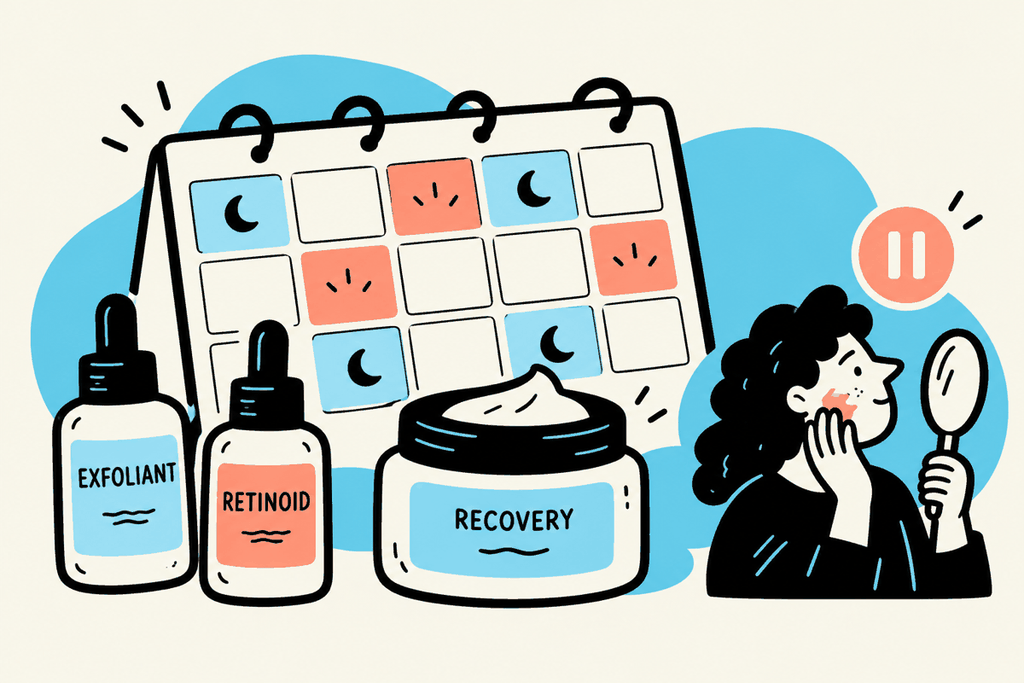
“Skin cycling” became a major viral skincare trend internationally, popularized by a US dermatologist’s structured rotation of exfoliant nights, retinoid nights, and recovery nights. What’s less discussed is that Korean skincare culture had its own, somewhat different version of ingredient rotation and recovery-focused thinking well before the term “skin cycling” went viral. Here’s how the two compare.
What the Viral “Skin Cycling” Trend Actually Prescribes
The popularized version follows a strict four-night rotation: Night 1 exfoliation (AHA/BHA), Night 2 retinoid, Nights 3-4 recovery (moisturizer only), then repeat. It’s a clean, easy-to-follow framework that became popular specifically because of its simplicity and structure.
The Korean Approach: Less Rigid, More Responsive
Korean skincare culture, as covered in our skin barrier repair guide and our PHA/AHA/BHA guide, generally favors a more flexible, skin-responsive approach over a fixed calendar rotation. Rather than a strict every-other-night schedule, the underlying philosophy is:
- Exfoliate based on how skin currently feels and looks (typically 2-4x weekly, but adjusted up or down based on visible texture and sensitivity)
- Introduce stronger actives gradually, one at a time, rather than following a preset weekly grid
- Treat “recovery” not as a scheduled off-night but as an ongoing baseline state the skin should mostly stay in, with active nights layered in only as needed
This is a subtly different philosophy: the viral trend structures a routine around a fixed calendar, while the Korean approach structures a routine around continuously reading the skin’s current state.
Why This Difference Exists
Korean skincare culture’s strong emphasis on skin barrier health (피부장벽) as the central organizing concept, discussed at length in our dedicated barrier repair post, makes a rigid, universal schedule feel somewhat at odds with the broader philosophy. If barrier health is the priority and everyone’s barrier responds differently, a one-size-fits-all four-night cycle is seen as a reasonable starting template rather than a strict rule to follow indefinitely.
A Korean-Influenced Version of Skin Cycling
If you like the skin cycling concept’s structure but want to adapt it with Korean skincare principles:
- Start with a flexible template, not a fixed rule: use exfoliation nights and treatment nights as a rough guide, but skip an exfoliation night if skin looks irritated, rather than sticking rigidly to the calendar.
- Add a buffer layer on active nights: Korean routines frequently use Centella asiatica or similar soothing ingredients specifically to reduce irritation on treatment nights, rather than relying solely on rest nights for recovery.
- Treat “recovery” as the default state, not a scheduled exception: most nights in a Korean-style routine are inherently gentle (hydration-focused), with actives added in only when the skin is ready, rather than actives being the default with recovery nights as the exception.
- Layer hydration generously regardless of which “cycle night” it is: unlike the viral version’s minimalist recovery nights, Korean routines tend to maintain multiple hydrating layers (toner, essence, moisturizer) every night, reserving the “cycling” logic specifically for when to introduce actives.
Which Approach Is Better?
Neither is objectively superior. They reflect different organizing philosophies.
- The viral four-night cycle works well for people who want structure and find decision fatigue overwhelming. A clear calendar removes the need to constantly assess skin condition.
- The Korean, more responsive approach works well for people who’ve built enough skincare literacy to read their own skin’s signals and adjust accordingly, and who prioritize long-term barrier health over a fixed routine structure.
Many people find a hybrid works best: using the viral cycle’s basic structure as a starting template for the first few months while new to actives, then gradually shifting toward the more flexible, skin-responsive Korean approach as they build a better sense of their own skin’s tolerance.
Questions We Get Asked
Can I follow the strict 4-night cycle and add Korean-style Cica products?
Yes. This is a very reasonable hybrid, using Cica or Centella products on both exfoliation and retinoid nights specifically to reduce irritation risk within the structured framework.
Is skin cycling necessary if I already follow a Korean-style routine?
Not necessarily as a strict system, though the underlying principle (not stacking multiple strong actives on the same night) is already built into most well-constructed Korean routines.
Does skin cycling work for sensitive skin?
Both approaches can work, though sensitive skin often benefits more from the Korean-style responsive approach, since a fixed calendar doesn’t account for day-to-day fluctuations in sensitivity.
Should You Care About Skin Cycling?
Skin cycling’s viral popularity introduced a useful structural concept, but Korean skincare culture had already been practicing a more flexible, barrier-focused version of the same underlying idea for years, prioritizing responsiveness to the skin’s actual state over a fixed calendar. Combining the viral trend’s easy-to-follow structure with Korean skincare’s emphasis on soothing buffer layers and barrier-first thinking offers a reasonable middle ground for most routines.
Read Next
“Chok-Chok” Skin Explained: Korea’s Other Dewy Skin Ideal
Chok-chok (촉촉) describes a moist, supple feel. In Korean skincare language, “chok-chok skin” means skin…
The Cushion Compact: How a Korean Invention Changed Global Makeup
A cushion compact is liquid complexion makeup held in a reservoir, usually a sponge, inside…
Why Korean Beauty Trends Cycle So Fast
Anyone following K-beauty for even a couple of years notices the pattern: an ingredient or…
Glass Skin Explained: Is It Actually Achievable?
Glass skin is a describable goal built on hydration, gentle exfoliation, barrier care and sun protection. Here is what it means and how achievable it really is.
K-Pop Idol Skincare Routines: Fact vs. Marketing
“K-pop idol skin” has become one of the most powerful (and most exploited) marketing angles…
The “No-Makeup Makeup” Look and Its Skincare Foundation
The “no-makeup makeup” look (민낯 메이크업 or 쌩얼 메이크업 in Korean) is makeup designed to…