Where to Buy Authentic K-Beauty Products Online (Avoiding Fakes)
For US shoppers, start with a brand’s official website or its country-specific authorized retailer list. If you need your order soon, compare stock status, processing time and delivery time separately. An attractive storefront or an Amazon brand page alone does not tell you who is selling the item in your cart.
This guide compares buying routes and the checks I would make before ordering. It is based on published retailer policies, checked on October 8, 2026, rather than a delivery-speed test or a promise that every order will arrive on schedule.
Where to Buy Authentic K-Beauty in the US
A useful example is Beauty of Joseon’s authorized retailer directory. It lists retailers by market, including international sellers such as YesStyle and Stylevana, and US sellers such as Sephora. Authorization for one brand does not establish authorization for every brand a store carries. Start with the directory for the exact brand you want.
| Buying route | Shipping information to check | Returns and authenticity checks |
|---|---|---|
| Official brand website | Confirm that the official site serves your US address and check the dispatch estimate. | Follow the brand’s own regional links. Read the return rules before opening the product. |
| Soko Glam | Orders and shipping says orders ship from a US warehouse. Confirm current processing and delivery estimates. | Its return policy covers new and gently used products within 30 days of delivery, with conditions and fees. Check the exact product eligibility. |
| OLIVE YOUNG US | Its US shipping policy lists 1 to 2 business days to ship, then up to 5 business days in the contiguous US or 9 for Alaska/Hawaii. These are estimates. | Use the US site and its US return policy. Change-of-mind returns require unopened, unused items; requests are subject to approval. |
| YesStyle | Check each item’s availability and the destination-specific shipping information. Dispatch readiness and courier transit are different. | Verify brand authorization separately. Read return conditions, including cosmetic exclusions, before buying. |
| Stylevana | The US FAQ states that orders ship from Hong Kong. An express option does not remove a wait for stock. | The FAQ describes a 14-day return-request period, subject to its terms. Check unopened-item requirements and the return address. |
The OLIVE YOUNG US policy checked for this guide lists standard shipping at $6.95, free on orders of $35 or more before applicable taxes. Thresholds and policies can change. Its Global and US stores have separate pages and conditions, so do not apply an old Global shipping estimate to a US order.
If Fast US Delivery Is the Priority
Compare an in-stock domestic option first, then an international option using the complete landed cost. A US warehouse may reduce international transit, but it does not guarantee immediate dispatch. Do not choose a “fastest retailer” from a single review or from the courier’s advertised transit time alone.
Before paying, record the item’s stock status, the processing estimate, the selected delivery service, taxes and any import charges. If the order is for a trip or gift, allow room for delays. A basket containing one backordered product may have a different dispatch date from the other items.
How to Check an Amazon Listing
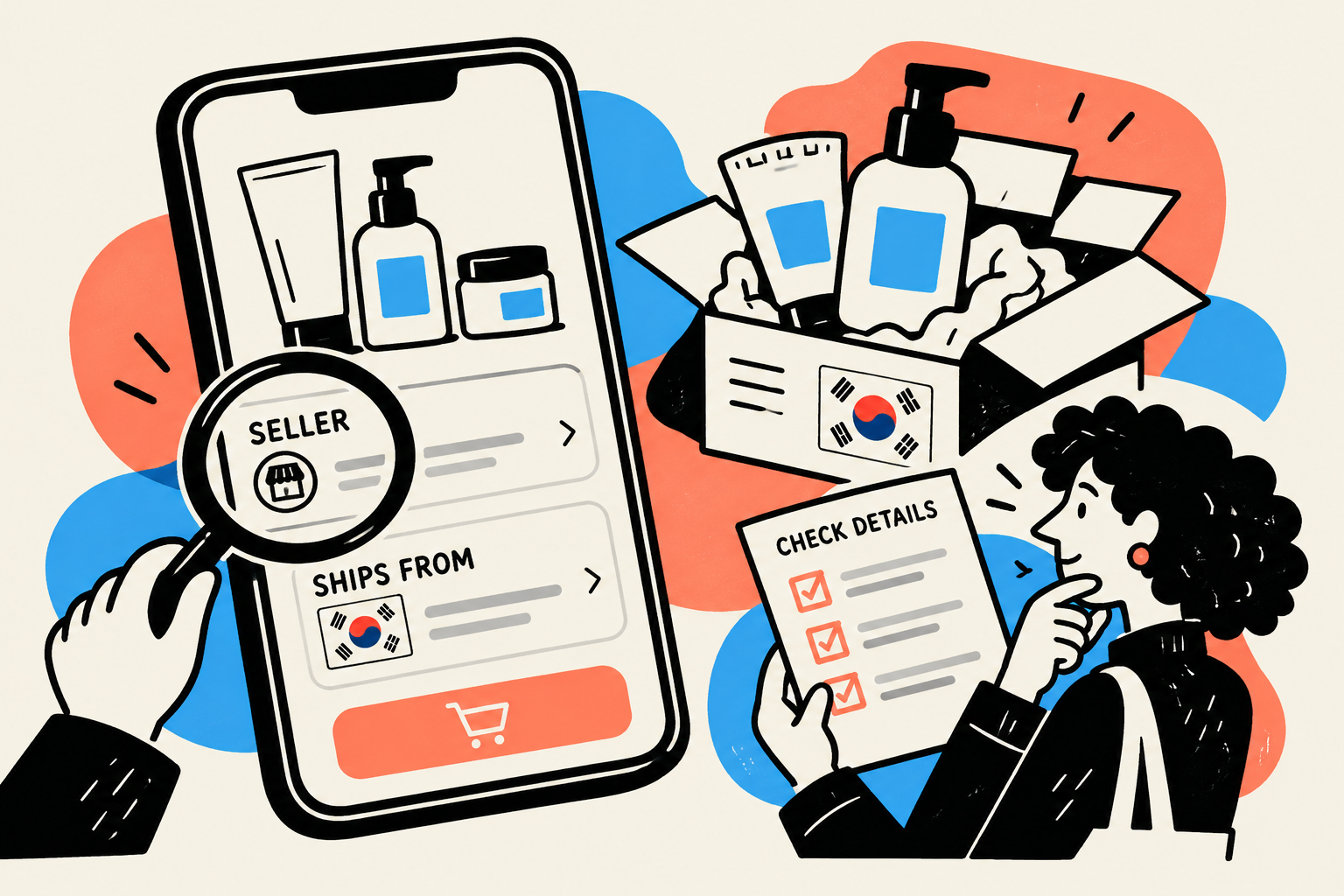
Open the marketplace link supplied by the brand, then inspect the seller shown on the actual offer. The brand store is a navigation page; “Sold by” identifies the seller and “Ships from” identifies fulfillment. These are separate pieces of information. A familiar brand header does not validate every offer.
For Beauty of Joseon, use its official Amazon purchasing guidance and retailer directory rather than a seller name that merely looks official. If you cannot establish the seller’s connection to the brand, ask the brand or choose another authorized channel.
Warning Signs Are Reasons to Investigate, Not Proof
A very low price, unclear seller details, inconsistent packaging or an unexpected batch label should prompt a closer check. Discounts alone cannot establish a fake: promotions, clearance stock, sizes and regional versions can explain price differences. Compare the same product, size and version.
Texture, scent and colour can also change with reformulation, storage or regional versions. An irritation reaction does not prove counterfeiting, and comfortable skin does not prove authenticity. Stop using a product that causes a concerning reaction and investigate its identity separately.
What to Do After a Suspicious Order Arrives
Keep the packaging, batch code, receipt and seller details. Photograph the item and compare its exact name and version with the brand’s regional listing. Contact the brand with these details. Use a verification code or batch tool only if the brand itself provides or endorses it.
Contact the retailer or marketplace promptly, because reporting and return windows differ. Do not open a product just to test its smell if opening it would make a return ineligible. For an adverse reaction, seek appropriate medical advice rather than repeatedly trying the product to diagnose whether it is genuine.
Is Buying in Korea Always Cheaper?
No. Compare the final cost per millilitre or gram, including promotions, currency conversion, delivery and taxes. An overseas sale can beat a Korean shelf price. In Korea, established retailers and department-store counters are practical purchasing routes, but there is no need to describe any route as foolproof. For an in-person trip, see the Olive Young shopping guide.
A Short Pre-Order Checklist
Confirm the brand and exact version; follow an official or authorized link; check the actual seller; separate dispatch time from delivery time; compare the final price; and read the return rules. Those checks are more useful than a fixed discount percentage or a list of supposedly safe packaging colours.
Read Next
What “기능성화장품” on a Korean Label Actually Means
Korea’s “functional cosmetic” label means a product’s brightening, anti-wrinkle or UV claim has been checked by the MFDS. Here’s what it covers, how products earn it, and what it doesn’t promise.
Olive Young Shopping Guide for First-Time Visitors
Olive Young is Korea’s dominant beauty and health retail chain, and for anyone visiting Korea…
Beauty of Joseon vs Anua, a Product Pick Guide
This is a pick guide rather than a verdict on which brand is better. It…
Why Sheet Masks Are Everywhere in Korea (And How to Actually Use Them)
Sheet masks are one of the most immediately recognizable K-beauty exports, thin, essence-soaked sheets sold…
What Does “Cruelty-Free” Mean for Korean Beauty Brands?
“Cruelty-free” labeling is more complicated for Korean cosmetics brands than for many Western brands, due…
Physical vs. Chemical Sunscreen: The Korean Perspective
The physical-versus-chemical sunscreen debate plays out differently in Korean skincare culture than in many Western…